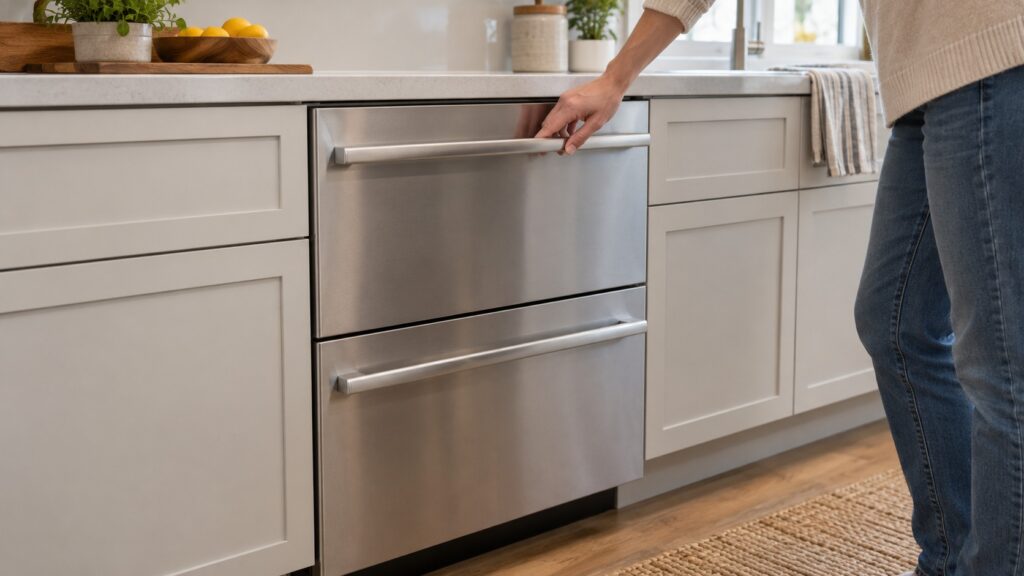
People search for “Fisher Paykel double dishwasher drawer worth repairing” when a drawer stops working, and the honest answer depends less on age than on what has failed. Because each drawer is an independent machine, a failure in one drawer leaves the other running, and the repair is limited to the parts of the drawer that failed. A seal, a valve, a pump, a heater or a control in an otherwise sound unit is usually a repair that returns the drawer to full service for far less than the cost of a new unit. Replacement makes sense when several major parts are failing at once, when the cabinet or tub is damaged or when the same fault keeps coming back.
How does the two-drawer design change the decision?
It narrows it. Our DishDrawer one drawer not working guide explains that the drawers share only supply, drain and power, so if one drawer works, the shared parts are proven good and the fault belongs to the other drawer alone. A technician is therefore fixing one drawer’s valve, seal, pump, heater or control, not rebuilding a machine. The flip side, noted in our DishDrawer vs dishwasher guide, is that two drawers mean two motors, two pumps and two valves, so there is more to maintain over a decade. That is a reason to keep the unit in good condition, not to give up on it.
What usually fails, and is it worth fixing?
The seal is the most common wear part, and our seal and gasket care guide says only a cracked or flattened seal needs a new part, since most seal complaints are debris. Fill problems usually point to the inlet valve or hoses, drain problems to the pump or a blocked filter, and wet dishes to the heater. Our F1 and F2 error codes guide and the heating element problems guide cover two of the more common cases. In a sound unit, each of these is a modest repair compared with a new built-in dishwasher plus installation.
What should you rule out before paying for a repair?
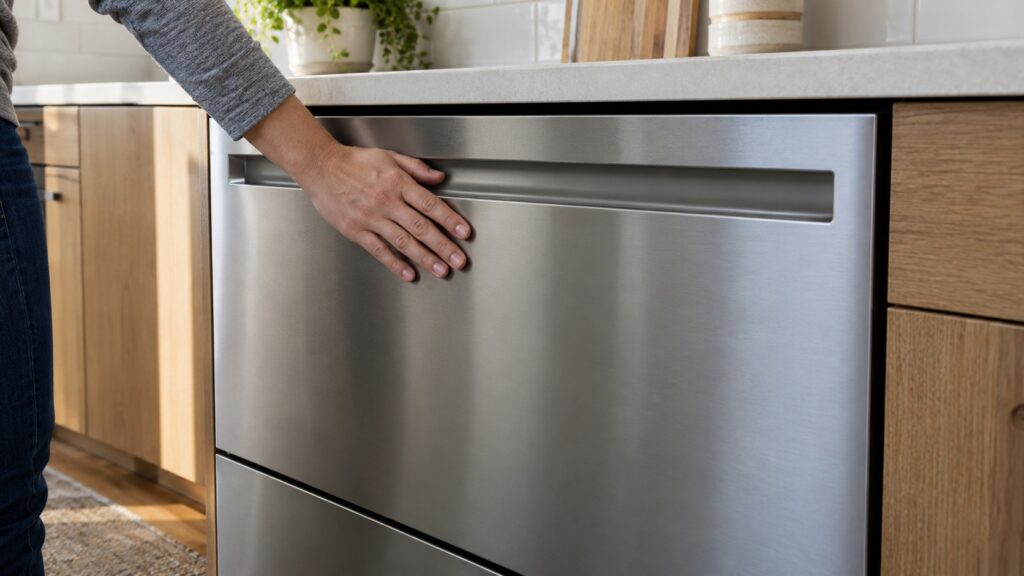
Do the owner-level checks. Clean the filter, as the filter cleaning guide describes, because a clogged filter mimics a drain fault. Wipe the seal and the tub rim, and check that nothing tall stands above the drawer edge. Make sure the tap is open and the supply is not kinked, and that no lock or setting is active. Check the household breaker and the water supply. If one drawer works and the other does not, note which and what it does, because that is the most useful information a technician can have. Do not open panels or pull the unit from its cabinet.
When does replacement make sense?
When several major parts fail together, when water has damaged the cabinet or the electronics, when the tub or frame is damaged, when the same fault keeps coming back after repair or when the cost of repair approaches the cost of a new unit. Consider the cabinet too: a replacement must fit the opening and the panel arrangement, and may need plumbing and electrical work. Our repair or replace dishwasher guide gives the general framework, and our dishwasher repair cost guide explains how we handle estimates. We do not quote figures here, since the right number depends on the model and the fault.
What should you ask a technician?
Ask which drawer is affected and which part failed, whether the other drawer shows signs of the same wear and whether the replacement part is one that fits your model. Ask what else was checked while the drawer was open and whether anything else is likely to fail soon. Ask for an estimate before work begins and compare it with a replacement that includes installation and any cabinet changes. If the unit has a panel fitted, ask how it will be handled during the repair. A clear description of the symptom, the model number from the rating plate and the answers to these questions are enough to decide with confidence.
Does the age of the unit matter?
It matters, but less than the pattern of faults. A unit that has run for years with a single failure now is a very different case from a unit that has needed several repairs in a short time. Look at the whole history: what was fixed, how long ago, and whether the same part has failed again. Our appliance lifespans guide gives the general picture of how long appliances tend to last, and your own history with this unit is more useful than any average. A drawer that has been well maintained, with a clean filter and a clean seal, usually has more life in it than one that has been neglected.
Also think about how you use it. A household that runs the unit twice a day wears the parts faster than one that runs it twice a week, and a household that relies on running two drawers at once will miss the second drawer far more than one that mostly runs one. If you would be happy to run on one drawer for a while, a repair of the other can wait, but do not let a leaking drawer sit unfixed.