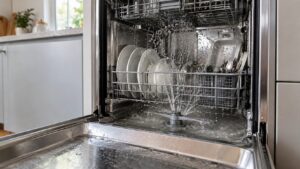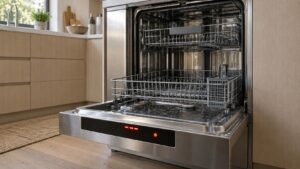
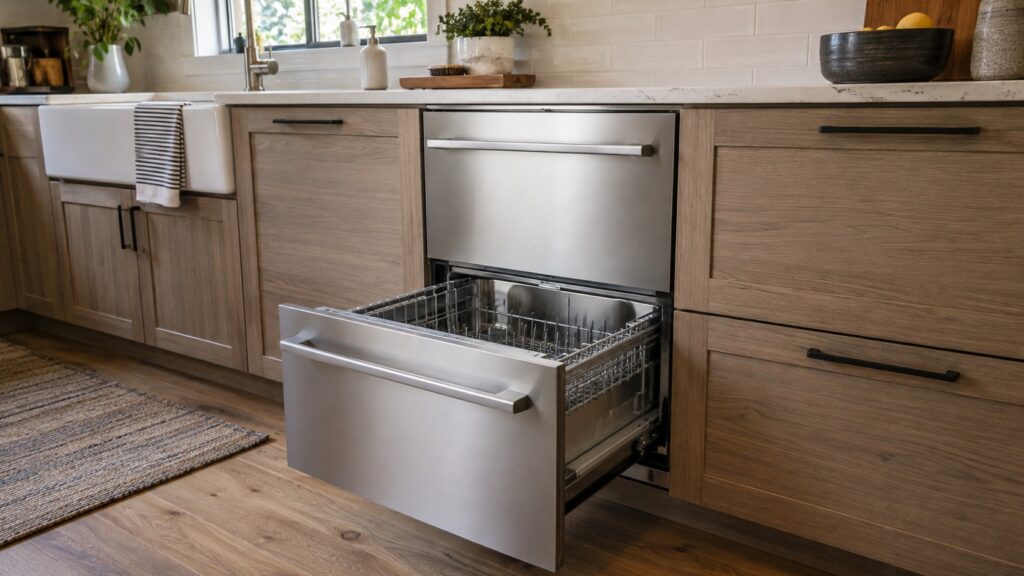
On a double DishDrawer, one drawer failing while the other works perfectly is the most common call this appliance generates — and it is also the most useful symptom in the whole brand, because it eliminates half the machine before anyone opens a panel. A Fisher Paykel DishDrawer not working on one side is rarely a plumbing problem and almost never a supply problem. This guide explains why, and walks the checks in the order that finds the fault fastest.
Start by naming the failure precisely
“Not working” covers four very different faults, and they lead to different parts. Does the drawer refuse to start at all? Does it start and stall at fill? Does it wash but leave water in the bottom? Or does it run through and leave dishes dirty or wet?
Stand and watch one cycle from the start. The first ninety seconds tell you most of it: you should hear the drawer seal, then water entering. No seal means a lid or safety problem; seal but no water means fill; water but no wash sound means the motor or pump.
If it will not seal or will not start
The lid has to close and seal before anything else happens, and the drawer will refuse to run if it cannot confirm that. Clear the sealing face with a damp cloth, check that nothing in the load stands above the drawer edge, and look for a plate lifted by a fallen utensil. Then close the drawer firmly and watch whether the lid mechanism travels.
If the drawer still will not seal, the mechanism or its sensing is the next step, and our page on a drawer that will not seal covers it. One thing to avoid: repeatedly slamming the drawer to make it catch. The lid system is not helped by force, and the parts it bends are not cheap.
If it will not fill
Because the other drawer fills, the tap, the supply hose and the house pressure are proven. What is left is that drawer’s inlet valve, its own hose run and its control. There is nothing an owner can safely test there beyond confirming that the tap is fully open and that no hose is kinked behind the cabinet.
A fill fault usually announces itself with a fill code, and our page on a drawer that will not fill explains what the panel is saying. The distinction worth carrying into the call is simple: both drawers failing to fill is a supply problem; one drawer failing to fill is that drawer’s valve.
If it will not drain
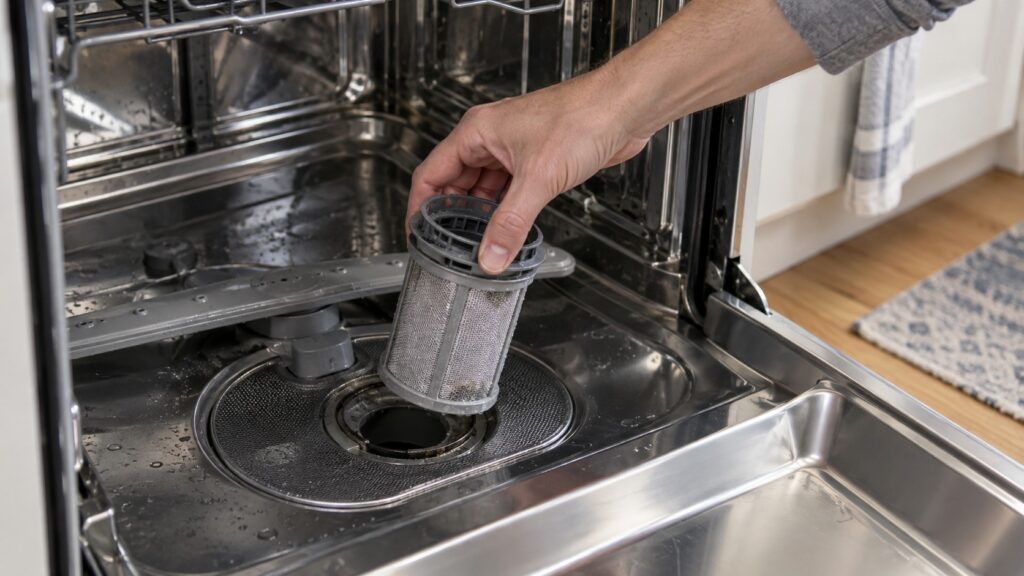
Here the shared drain connection does come into play, so look at both drawers before concluding. Standing water in one drawer only points at that drawer’s pump, its filter or the debris in front of it — and the filter is the first thing to pull, because it is the one part an owner can clear.
Standing water in both drawers, or water appearing in the lower drawer when the upper one runs, points at the shared drain path — a blocked household drain, a disposal that was fitted without removing its knockout plug, or a drain hose that has lost its high loop. Our guide on a drawer that will not drain walks both cases.
What a technician does with your description
Four sentences, four different vans. This is the appliance where a precise description saves the most money, because a vague one means a first visit spent finding out what you already knew.
What not to do
Do not run the working drawer harder to compensate; a drawer with a fault that is being ignored can leak into the cabinet below it. Do not keep resetting a flood-protection trip — that system exists because water was detected outside the drawer, and repeated resets are how a small leak becomes a kitchen floor. And do not swap parts between drawers to test, however tempting the symmetry looks: the two drawers are not always identically specified, and a mismatched part can leave you diagnosing two faults instead of one.
Routine care helps more than most owners expect. Both filters, cleaned on the same schedule, prevent the majority of drain and cleaning complaints — the routine is in our guide on cleaning the filter.
One habit is worth building while you wait for a visit: use the working drawer and leave the faulty one alone, with its drawer closed and the household warned off it. A drawer that half-fills or half-drains is the one that puts water where it should not be, and an appliance built into cabinetry gives a leak a long, quiet path before anyone sees a drop on the floor.
There is one owner test that narrows the diagnosis further and costs nothing: run the same short cycle on both drawers, one after the other, and watch each for the first two minutes. Identical behavior on both means the fault is intermittent or shared; different behavior confirms which drawer owns it. Note what you saw — sealed or not, water or not, sound or silence — and that description is worth more to a technician than the code on the panel.
When to call
Call when one drawer will not fill with the other working, when a drawer will not seal after the load and sealing face have been checked, when water stands after a cycle and the filter is clear, or when flood protection has triggered at all. Each drawer is a machine in its own right, and the parts that fail are the ones that machine owns.
We are an independent repair company, not a factory service arm. Pricing starts from a diagnostic visit — from $129 — with the estimate confirmed before work begins. Fisher Paykel dishwasher repair covers motors, pumps, inlet valves, lid seals and controls on single and double units, and you can schedule a visit online.