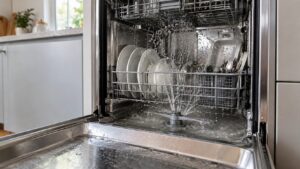
What Not Drying means (fisher paykel dishwasher not drying)
When a fisher paykel dishwasher not drying is the concern, it is an observable condition — dishes come out wet. DishDrawer drying relies on the final hot rinse and residual heat, so low rinse aid, a heating problem (which can also throw F4), or poor loading are the usual causes.
Symptoms to look for (fisher paykel dishwasher not drying)
Drying trouble is judged at the end of the cycle, when you open the drawer and find moisture still clinging to the load. Plastics are the giveaway — they hold beads of water long after china and glass have dried — and the problem often creeps in slowly as rinse aid runs low rather than failing overnight. If an F4 heating code has appeared alongside the wet dishes, that points past loading toward the heating circuit. Use the list below to tell a simple drying shortfall from a heater failure.
- Dishes are wet at the end of the cycle
- Plastics especially stay damp
- It may have worsened gradually
- An F4 heating code may appear
Likely causes
DishDrawer drying has no fan — it leans on a hot final rinse and the heat the dishes hold afterwards. That means most poor-drying cases come down to water not sheeting off (low rinse aid), water not getting hot enough (a heating problem), or items arranged so they cup water. Sorting the owner-fixable causes from a genuine heating problem that needs trained service and the correct Fisher & Paykel parts is the goal here.
- Low rinse aid — water beads instead of sheeting off
- Heating problem — the final rinse is not hot enough
- Poor loading — items pool water
- Short cycle chosen — less drying heat
What you can check
Start with the two things you control directly: rinse aid and how the load sits. Top up the dispenser, re-stack so water can run off rather than collect, and pick a cycle with a proper hot rinse before assuming a part has failed. Note what improves and what does not — if drying stays poor or F4 shows, that record helps a technician focus on the heater. Leave the heating element, live wiring, or any sealed part to a qualified technician.
- Top up the rinse aid and check the dispenser dose.
- Load items so they drain rather than cup water.
- Use a cycle with a hot final rinse.
- If drying stays poor or F4 shows, book service for the heater.
Parts a technician may check or replace
Depending on what the diagnosis shows, a technician may inspect, test, or replace the rinse aid, heating element, temperature sensor, and load arrangement. The correct part for your Fisher & Paykel Dishwasher is matched from the model and serial number, and genuine components are fitted through trusted parts suppliers rather than generic substitutes so that performance, safety, and the appliance’s long working life are all protected. Confirming the failed part before ordering avoids replacing more than the problem actually requires.
When to call a technician
Poor drying with good rinse aid and loading, or an F4 code, needs a technician to test the heating system. When the fix calls for trained service, book a visit through our scheduling page and an experienced, qualified technician will diagnose and repair it.
Prevention and care
Consistent drying is mostly a matter of habit: keep the rinse-aid reservoir topped up, load so plates and cups drain rather than trap water, and use a hot final-rinse cycle for mixed loads. Watch the trend, too — drying that fades gradually usually means rinse aid is running low, while a sudden drop with an F4 code points at the heater. If you do book service, mention when the change started so a technician can decide quickly between a settings issue and a heating problem.
Related help and Fisher & Paykel resources
Browse other Fisher & Paykel Dishwasher diagnostics, read about Fisher & Paykel Dishwasher repair, look up your unit in the Fisher & Paykel models reference, or the related F4 heater/sensor failure, browse service locations, or schedule a service visit. For Fisher & Paykel manufacturer documentation and model lookup, visit Fisher & Paykel at fisherpaykel.com/us.