A Fisher Paykel dishwasher F1 error is not a general “something went wrong” warning. On a DishDrawer whose model number ends in 9, F1 means one thing: the flood switch under the chassis has been lifted by water that reached the base of the machine. F2, its neighbor on the same control board, means something completely different — the wash motor rotor stalled or drew more current than the board allows. Two codes, two unrelated parts, and the drawer stops for both.
What does F1 mean on a Fisher and Paykel DishDrawer?
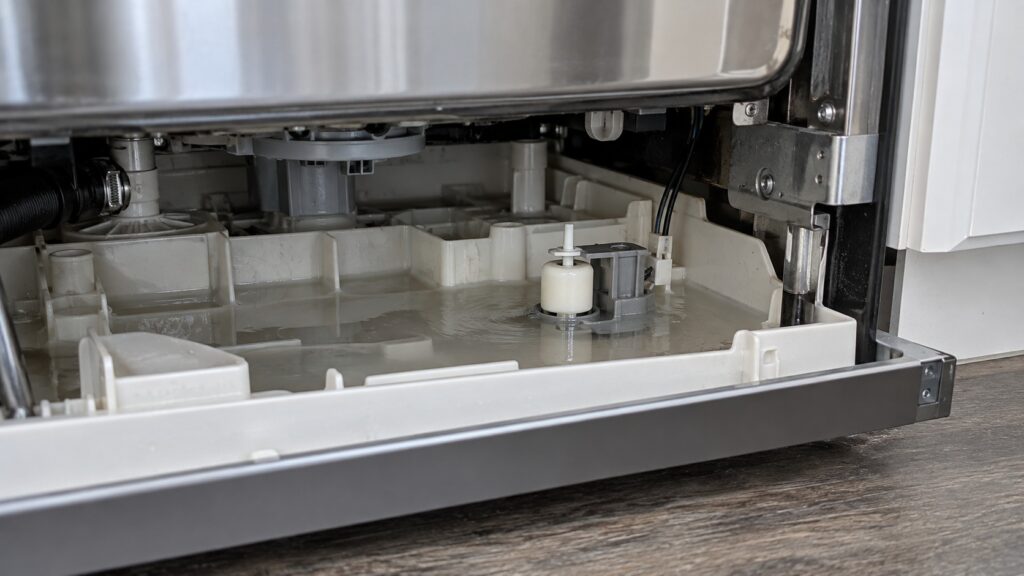
Every DishDrawer sits on a molded chassis base with a float and a switch in it. The float has one job: to rise when water collects where water should never be. When it rises, the control board raises F1, shuts the wash cycle down and, on most of the ending-9 generation, runs the drain pump to move whatever it can reach.
That behavior confuses owners, because the machine looks like it is running while the panel says it has failed. It has not failed. It is protecting the floor and the cabinet the drawer is built into. The pump will keep running until the float drops, which is why F1 on a unit left alone overnight is sometimes accompanied by a pump that has been cycling for hours.
The important thing about F1 is what it does not tell you. It reports water in the base. It says nothing about where that water came from. A split inlet hose, a lid seal that stopped sealing, a cracked sump, a spray arm bearing, condensation from an over-hot cycle on a badly vented install — all of them end with water in the same tray and the same code on the panel.
What does F2 mean, and why is it not the same problem?
F2 comes from the other end of the machine. The wash motor in a DishDrawer is a small brushless unit sitting directly under the tub, and the board watches how fast the rotor turns against how hard it is being driven. When the rotor cannot reach speed, or reaches it only by drawing more current than the board permits, the cycle stops and F2 appears.
The common cause is mechanical and harmless: a fruit pit, an olive stone, a screw, a shard of glass or a bit of bone that worked past the filter and lodged against the impeller. The motor tries, the rotor stalls, the board calls it. Less often the fault is electrical — a winding that has gone open, or the motor drive section of the control board itself.
One practical clue separates the two. If F2 appears the moment the wash phase should start and repeats at the same point in every cycle, something is physically in the way. If F2 appears at random points in different cycles, or the drawer runs fine for a week and then throws it twice in a day, suspect the motor or the board.
What can I check myself before calling anyone?
For F1, water comes first and diagnosis second. Cut the power at the wall or the breaker. Pull the drawer fully open and look at the tub: standing water in the tub is a drain issue, while a dry tub with F1 on the panel means the water is underneath, out of sight. Slide a flashlight along the floor of the cabinet and under the front kickplate — if you can see or feel dampness, stop there and leave the drawer out of service until someone has looked at it.
For F2, cut the power, take out the lower rack and lift the filter plate. Run a finger carefully around the impeller housing — carefully, because a fragment of glass is one of the things that causes this code. Anything you can lift out cleanly, lift out. Then restore power and start a short cycle and listen: a healthy DishDrawer motor is a soft even hum, while a stalling one makes a brief buzz and stops.
- Power down for two minutes. Both codes are latched. A drawer that has cleared a genuine fault still shows the code until the board restarts.
- Run the drawer empty on the shortest cycle. If the code returns at exactly the same moment, the condition is live rather than remembered.
- Check both drawers on a double unit. They have separate motors and separate flood switches but share the drain and the supply. One drawer faulting is a drawer problem; both faulting together points at the plumbing.
- Write the model number down. The last digit decides which code table applies, and a technician will ask for it before anything else. Our guide on one drawer not working explains why the two halves fail separately.
Stop before you tip the unit, pull it from the cabinet, or open the chassis base. The flood tray sits directly beside the mains wiring and the water circuit, and the drawer is heavy and awkward once it is off its runners.
How do I reset the drawer after an F1 or an F2?
There is no secret button sequence. Both codes clear on a power cycle, and both come straight back if the condition that raised them is still there. On the ending-9 drawers, holding the power key for a few seconds shuts the panel down but does not reset the board; only removing power at the breaker does that.
What matters more is drying the base. A float that is still sitting in water will re-raise F1 within seconds of the board coming back. If the water arrived from a one-off event — an overfilled detergent dose that foamed over, a hose union that was loose from installation day — the drawer may run normally once the tray is dry. If F1 returns on a dry tray, water is still arriving from somewhere, and running the drawer again just puts more of it under the cabinet.
When does F1 or F2 mean a service visit?
F1 that returns after the base has been dried is a leak, and leaks in a DishDrawer are found by removing the drawer from its cabinet — a two-person job on most installs, with the water supply and the drain to disconnect first. That is the point to stop. The flood detection itself is doing exactly what Fisher and Paykel flood protection is designed to do; the fault is upstream of it.
F2 that survives a filter check and an impeller inspection is a motor or a board, and both need a meter and the service data to tell apart. Swapping one on a guess is an expensive way to find out you needed the other.
We are an independent repair company, not a factory service arm. Pricing starts from a diagnostic visit — from $129 — with the estimate confirmed before work begins. Fisher Paykel dishwasher repair covers flood switches, wash motors, lid seals and control boards on single and double drawers, and you can schedule a visit online. Have the model number and the code on hand when you call: with an ending-9 drawer, those two facts are most of the diagnosis.