What Water In Base / Flood means (fisher paykel dishwasher flood)
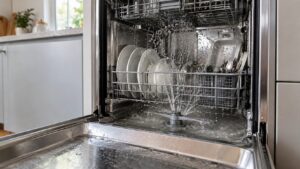
When a fisher paykel dishwasher flood or water-in-base condition appears, it is an observable leak that trips the anti-flood protection (shown as F1 on later units or E6 on classic ones). Because water has reached the chassis base, treat it promptly and avoid restarting until the leak is found.
Symptoms to look for (fisher paykel dishwasher flood)
A flood problem shows itself the moment water escapes where it should not be. The clearest sign is moisture pooling under or behind the cabinet, often paired with a drawer that has stopped mid-cycle and an F1 or E6 on the display. Sometimes the anti-flood float has already tripped before you spot any water at all. Because a leak can start small at a seal or hose and then worsen, match what you see to the list below and act on it rather than waiting for it to clear on its own.
- Water is visible under or behind the unit
- The drawer stops and may show F1 or E6
- The anti-flood protection has tripped
- It may follow a seal or hose leak
Likely causes
A water-in-base trip means liquid has found its way to the chassis tray, so the question is simply where it came in. Most flood causes are a failed seal, a loose joint, or a cracked part somewhere in the wash circuit — finding that source is what lets a technician fit the correct Fisher & Paykel parts and reset the protection safely.
- Leaking seal or hose — water reaches the base
- Tripped flood switch — water detected at the switch
- Loose fitting — a connection drips
- Cracked component — a tub or hose leak
What you can check
With a flood, the safe first move is to stop power and remove the standing water rather than chasing the leak with the machine live. Make the area dry and safe, look for the obvious drip point around the hoses, and note what you find — but because a leak can hide behind the chassis, this is one problem best handed to a technician early. Never restart over water in the base, open a sealed system, or bypass the flood switch.
- Switch off at the breaker and mop up any water.
- Do not restart while water is present in the base.
- Look for the visible leak source around the hoses.
- Because of the leak risk, book service.
Parts a technician may check or replace
Depending on what the diagnosis shows, a technician may inspect, test, or replace the tub/hose seals, flood switch, base tray, and hoses. The correct part for your Fisher & Paykel Dishwasher is matched from the model and serial number, and genuine components are fitted through trusted parts suppliers rather than generic substitutes so that performance, safety, and the appliance’s long working life are all protected. Confirming the failed part before ordering avoids replacing more than the problem actually requires.
When to call a technician
A flood condition needs a technician to find and fix the leak and reset the anti-flood protection. When the fix calls for trained service, book a visit through our scheduling page and an experienced, qualified technician will diagnose and repair it.
Prevention and care
The best guard against a repeat flood is keeping the wash circuit watertight. Have the hose connections and tub seals checked when the machine is serviced, watch for any early dampness behind the cabinet, and address a small drip before it grows into a base-tray trip. Because a leak puts water on the floor and triggers a safety lockout, treat any return of dampness as a reason to act quickly and note exactly when and where it appeared so a technician can pinpoint the source fast.
Related help and Fisher & Paykel resources
Browse other Fisher & Paykel Dishwasher diagnostics, read about Fisher & Paykel Dishwasher repair, look up your unit in the Fisher & Paykel models reference, or the related F1 flood switch, browse service locations, or schedule a service visit. For Fisher & Paykel manufacturer documentation and model lookup, visit Fisher & Paykel at fisherpaykel.com/us.