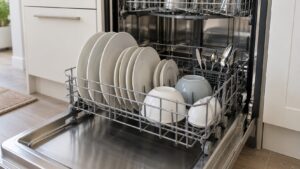
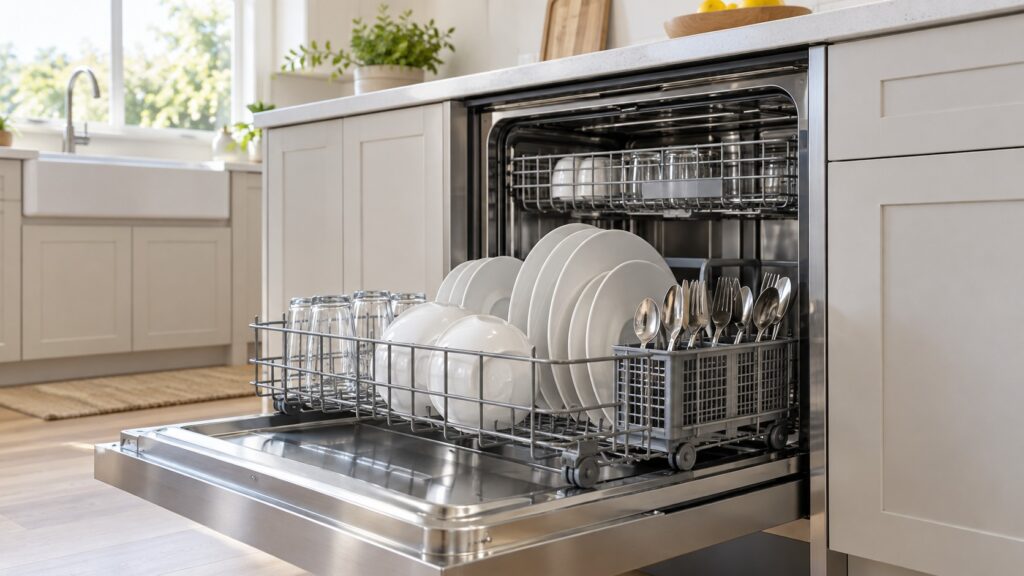
This guide covers the Fisher Paykel double drawer dishwasher how it works question in plain terms, because the design explains most of what owners notice. A DishDrawer is not one machine with two racks. It is a pair of independent washing machines stacked in one cabinet, and each drawer has its own motor, pump, spray, heater, lid seal, sensors and controls. The two share only the water supply, the drain connection and the power feed. That design is the point: a half load is a whole drawer rather than a half-empty tub, and two different cycles can run at the same time. It is also why a fault usually belongs to one drawer alone.
Why is a DishDrawer called two machines in one?
Because each drawer is complete. Our glossary of DishDrawer terms describes a drawer as a complete washing machine with a motor, pump, spray, heater and controls of its own. On a double unit the two drawers run independently, with different cycles, different times, one on and one off. The practical effect is that the drawers do not need each other to work, and a fault in one does not stop the other. If the top drawer cleans perfectly and the bottom will not fill, the shared supply and drain are fine by definition, and the fault sits in the bottom drawer’s own valve, hoses or control.
What happens when you close the drawer?
Instead of a door, the drawer has a lid that lowers and seals against the top edge. The drawer will not run until it can confirm that the lid is closed and sealed, so that is the first thing that has to happen in every cycle. Our guide on DishDrawer seal and gasket care explains that the seal compresses to keep wash water and steam inside, and that a drawer that does not seal is usually debris on the sealing face or a tall item standing proud of the drawer edge before it is the mechanism. Because each drawer has its own seal, one drawer can seal well while the other does not.
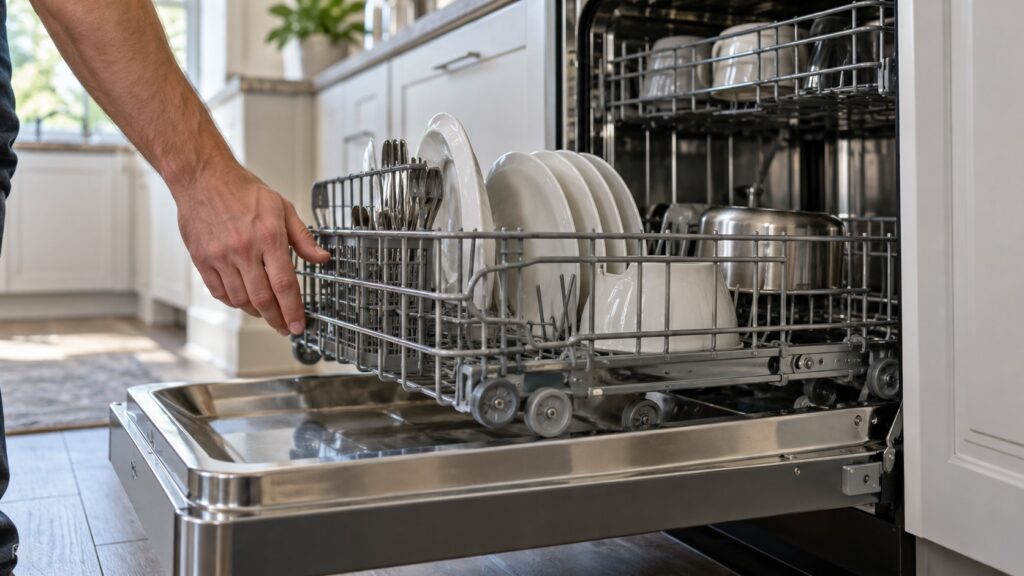
How does the wash itself work?
In general terms, a drawer fills with water through its inlet valve, a pump circulates it through the spray, the heater brings the water up to the temperature the cycle needs, and the pump then drains it. The details, including how many sprays, how the water path is arranged and which cycles exist, differ by model, so check your owner’s manual. Some Fisher & Paykel dishwashers use a soil-sensing system called PrecisionWash, which our guide on how PrecisionWash works says reads how cloudy the wash water gets and adjusts the temperature and cycle length. That is why pre-rinsing is counterproductive on those models: clear water reads as a light load and shortens the cycle.
How do the dishes dry?
Our DishDrawer glossary describes drying as residual heat rather than a fan: a hot final rinse and the heat the dishes hold do the work, which is why plastics, which hold little heat, often come out damp. Some Fisher & Paykel dishwashers use a different method, and our fan-assisted drying glossary describes a powered fan on Series 9 and 11 dishwashers. Our own pages describe drying differently for different models, so which approach your machine uses depends on its model and series; your owner’s manual is the reference. A heating fault shows up as wet dishes, since drying depends on that heat, so a drawer that washes well but dries badly should be described to a technician as such.
What does flood protection do?
A DishDrawer has protection that shuts the drawer down when water is detected where it should not be. Our flood protection guide explains the idea, and the glossary calls it a deliberate shutdown, not a nuisance to be reset again and again. If a drawer stops with a water-related alert, switch it off, do not keep restarting it, and do not open panels. If there is water near the outlet or a burning smell, switch off the breaker at the panel while standing on a dry floor, and never pull a plug from a wet outlet.
What does the two-drawer design mean for troubleshooting?
It halves the problem. The first question a technician asks is which drawer fails and whether it fails to start, fill, drain or finish. Name the failure precisely and watch one cycle from the start: you should hear the drawer seal, then water entering. Our guide on a DishDrawer with one drawer not working walks through that order, and the F1 and F2 error codes guide covers codes. Check the filter of the drawer that takes the dirtiest loads; our filter cleaning guide shows how.
When should you call a technician?
Call when one drawer will not seal after the sealing face is clean, when it will not fill or drain, when it shows a code that comes back, or when water is where it should not be. Do not open panels or reach into the drawer cavity. Our Fisher & Paykel dishwasher repair page explains how a visit works.
One last point about the design: because everything a drawer needs is inside it, the tub is shallower than a conventional dishwasher and you load it from above at a comfortable height. That suits half loads and smaller households, and it is why the drawer that gets the dirty pans needs its filter cleaned more often than the other.