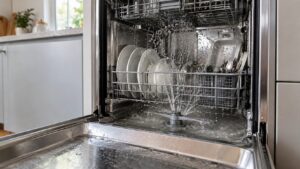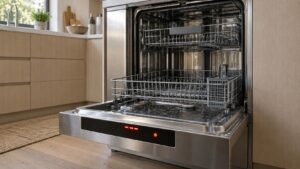
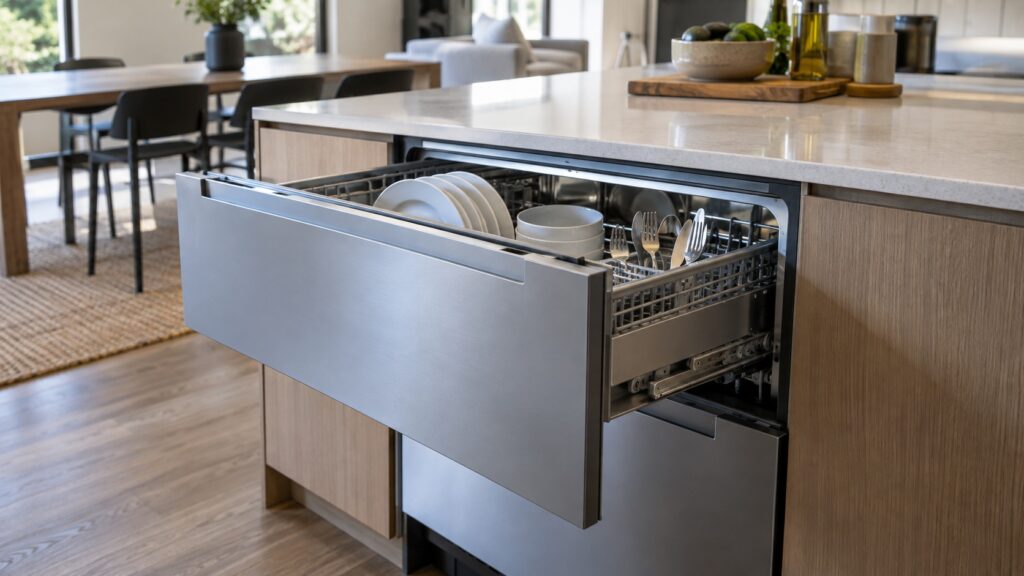
A Fisher Paykel DishDrawer is not a dishwasher with drawers in it. It is a pair of independent machines stacked in one cabinet, each with its own motor, its own water path and its own lid that seals it shut. Almost every complaint that sounds strange on this appliance makes sense once that is clear, so this glossary defines the parts and the words that come up on a service call — and what each one changes when something goes wrong.
Why “each drawer is its own machine” matters
On a double unit the two drawers run independently: different cycles, different times, one on and one off. That is the whole point of the design — a half load is a whole drawer rather than a half-empty tub.
It also means a fault usually belongs to one drawer. If the bottom drawer will not fill while the top one is perfect, the shared plumbing is fine by definition and the fault sits in that drawer’s valve, its hoses or its control. That single observation removes half the possibilities before anyone opens anything, and it is the most useful thing an owner can report on the phone.
The lid seal, and what it is not
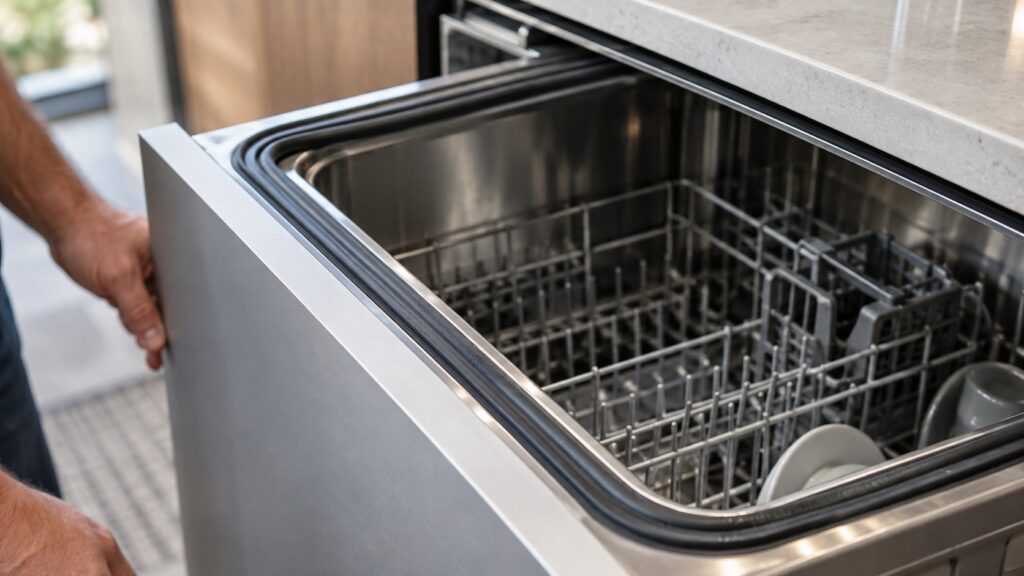
Instead of a door gasket the drawer has a lid that lowers and seals against the top edge. The seal is a wear part, and it is sensitive to two things: debris caught on the sealing face, and anything loaded tall enough to stand proud of the drawer edge. A drawer that will not seal, or that reports a seal problem, is usually one of those two before it is the mechanism.
Check the sealing face with a finger for grit and old detergent film, and look for a tall glass or a spatula handle that is holding the lid off by a fraction of an inch. Our page on a drawer that will not seal covers the rest.
Codes and what they point at
A7 deserves a note, because owners read it as a fault. It is the machine noticing suds and dealing with them — usually after too much detergent, or after dish soap has found its way in. A cycle that runs long with lots of foam is the appliance being sensible, and the fix is in the detergent drawer rather than in a toolbox.
Drying: why plastics come out wet
There is no fan-assisted drying here and no heated element blowing air. The final rinse comes in hot, the dishes hold that heat, and the water evaporates off them afterwards. Heavy ceramic and glass do well from this. Light plastics have almost no thermal mass, so they cool immediately and stay damp — that is physics rather than a fault.
What you control: rinse aid, loading so items are not cupped upward, and not opening the drawer the moment the cycle ends. If drying has become worse across everything, including heavy items, then heat is the suspect — check for the heating code and see our page on dishes that come out wet.
Words that travel badly
“Dishwasher.” Parts, cycles and service procedures differ between a DishDrawer and a conventional built-in machine, so a fix found online for a standard dishwasher often does not apply. Say “DishDrawer” and say which drawer.
“Filter.” Each drawer has its own filter assembly at the bottom, and both need cleaning — it is remarkably common to find one spotless and the other packed, because one drawer gets all the dirty pans. Our guide on cleaning the filter covers the routine.
“Series.” These units have run through several generations with different controls and different part numbers. The model and serial off the plate inside the cabinet settle which one you have, and they belong in any parts conversation.
How the names save a visit
Three sentences a technician is happy to hear. “The lower drawer will not fill; the upper one is fine.” “Both drawers run, but everything comes out wet and there is an F4 on the panel.” “It shows A7 every time we use the powder we just bought.” Each of those names a system, and each one means the van arrives with the right part or the problem is solved on the phone.
Compare that with “the dishwasher is broken,” which describes two machines, four subsystems and about a dozen possible causes, and leaves the technician to start from nothing on arrival. On this appliance more than most, the vocabulary is the diagnosis.
One last piece of vocabulary that decides a parts order: single versus double. A single unit is one drawer in a half-height opening; a double is two drawers in a standard dishwasher opening. They share a design idea and not a parts list, and the racks, seals and control panels differ between them. The model number off the plate settles it in one line, and it is the difference between a part that fits and a part that is returned.
When to call
Call when one drawer will not fill or drain with good supply, when a seal fault returns after the sealing face has been cleaned and the load checked, when flood protection has triggered, or when a heating code returns after a reset. Water and electronics share a cabinet here, and a flood-protection event is the appliance telling you it found water outside the drawer.
We are an independent repair company, not a factory service arm. Pricing starts from a diagnostic visit — from $129 — with the estimate confirmed before work begins. Fisher Paykel dishwasher repair covers motors, inlet valves, lid seals, heaters and controls on single and double DishDrawer units, and you can schedule a visit online.