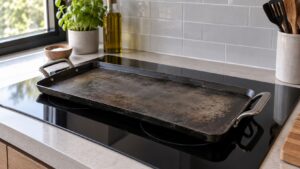
What Pan Not Detected means (fisher paykel cooktop pan not detected)
When a fisher paykel cooktop pan not detected message or behavior appears, it is an observable condition — the zone will not heat because it cannot sense suitable cookware. Induction needs a flat, magnetic (ferromagnetic) base of the right size, so non-magnetic or too-small pans are the usual cause.
Symptoms behind a pan not detected message
The giveaway with this one is that it is selective: the zone heats perfectly well for some pans and flatly refuses others, often flashing a pan symbol and beeping before it shuts that zone back off. That selectivity points away from a cooktop problem and toward the cookware, and a quick magnet test usually settles it — a magnet that will not grip the base tells you induction simply cannot work with that pan. Check the signs below, paying attention to whether the problem follows specific pans rather than the whole cooktop.
- The zone will not heat or flashes a pan symbol
- The cooktop beeps and shuts the zone off
- It happens with certain pans only
- A magnet does not stick to the pan base
Likely causes of a pan not detected message
Almost every “pan not detected” message comes down to the cookware failing one of induction’s three requirements: it must be magnetic, big enough, and sitting flat over the coil. Aluminium, copper, and glass simply will not couple to the field, while an undersized, warped, or off-center pan gives the coil too little to grip even if the metal is right.
- Non-magnetic cookware — aluminium, copper, or glass will not work
- Pan too small — below the zone’s minimum base size
- Warped pan base — poor contact with the surface
- Pan off-center — not seated over the coil
What you can check
Sorting this out at home is mostly about testing the cookware against what induction needs, and it takes only a minute. Hold a magnet to the pan base to confirm it grips firmly, choose a pan whose base matches or exceeds the zone’s minimum size, and set it squarely over the center of the cooking zone. If a known-good, properly centerd pan still goes undetected on that zone, the cookware has been ruled out and the zone’s sensing should be looked at by a technician.
- Check a magnet sticks firmly to the pan base.
- Use a pan that matches or exceeds the zone size.
- Center the pan on the cooking zone.
- If suitable pans still are not detected, book service.
Parts a technician may check or replace
Once a magnet-tested, correctly sized pan has been ruled out and detection still fails, the diagnosis turns to the zone hardware: the technician compares the cookware type and base against the zone size, then bench-tests the induction coil that does the actual sensing on that specific element. Whatever the testing identifies is sourced to match your Fisher & Paykel Cooktop by model and serial number through trusted parts suppliers, so a replaced coil reads cookware on the affected zone the way it should. Proving the pan sound before touching the coil keeps a detection repair from drifting onto parts that were never responsible.
Why a pan not detected problem needs a technician
Once magnet-tested, centerd cookware still draws a “pan not detected” response, only coil and sensing tests behind the glass will reveal why — work that needs a technician’s bench equipment. Use our scheduling page to arrange that visit, and an experienced, qualified independent technician will isolate the failing sensing component on the affected zone and put it right.
Prevention and care
Avoiding this message is largely a matter of cookware habits, since the cooktop is usually doing exactly what it should. Build a set of flat, ferromagnetic pans sized to your zones, retire any that have warped or developed a domed base over time, and get into the habit of centering the pan over the coil before you turn the zone on. Note when detection problems first appeared and what changed around the same time — a new pan, a warped favorite, or recent service — because that detail often points a technician straight to the cause and keeps the repair simple. If every suitable pan suddenly stops registering on one zone, that is the signal something has shifted in the sensing rather than the cookware.
Related help and Fisher & Paykel resources
If a pan-not-detected zone keeps refusing good cookware, compare it with other Fisher & Paykel Cooktop diagnostics, weigh up independent Fisher & Paykel Cooktop repair, and confirm your element layout in the Fisher & Paykel models reference; a dead zone is sometimes the related case of a cooktop that will not power on. Check coverage on our service locations page or go straight to schedule a service visit. For manufacturer documentation and model lookup, visit Fisher & Paykel at fisherpaykel.com/us.