On a Fisher Paykel oven, AeroTech is the name for the even-convection airflow system and ActiveVent is the moisture control that appears on supporting models. Those two words, plus the model letters OB, OS and OM and a short list of oven fault terms, are most of what you meet in the manual and on the service page. This glossary explains each Fisher Paykel AeroTech term in plain English, so you know what your oven has and what a technician means when they use the word.
What does AeroTech mean on a Fisher Paykel oven?
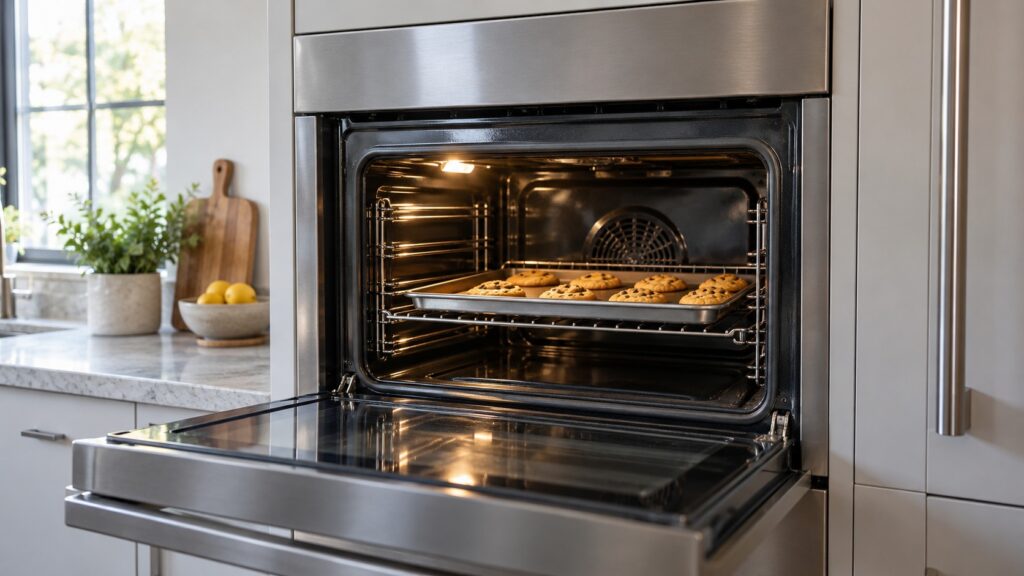
AeroTech is the convection system. Instead of relying only on heat rising from the elements, a fan circulates the hot air so the temperature is more even from the front of the cavity to the back and from the top rack to the bottom. In everyday cooking that means fewer pale spots on a tray of cookies and less need to rotate pans halfway through. Our model list shows AeroTech on the wall ovens, the combi-steam ovens, the compact speed ovens and the ovens inside the freestanding ranges.
It is a hardware feature, not a setting you switch on. What you choose on the dial or touchscreen is the cooking function, and the oven decides when the fan runs. If the fan is noisy, runs when it should not, or the oven bakes unevenly, the fan and its sensing are the first suspects. Our guide to Fisher Paykel oven features shows how the functions are used.
What is ActiveVent and which ovens have it?
ActiveVent manages moisture in the cavity while you bake. Bread, roasts and pastry want different levels of humidity, and a vent that opens and closes at the right moments helps the surface brown without drying the inside. The model list marks it as present on supporting models only, which is a polite way of saying not every oven has it. Check the model number on the rating plate and the description in the owner’s manual before you assume yours does.
ActiveVent is a different idea from steam. The combi-steam ovens add steam on purpose, while ActiveVent controls the moisture that food releases by itself. If you own a steam model, the water-tank routine is a separate chore, covered in our steam oven descaling guide.
What do OB, OS and OM mean in the model number?
The first two letters tell you the type of oven. OB is a built-in wall oven, usually a single or a double. OS is the combi-steam oven, which cooks with convection and steam together. OM is the compact speed oven, which combines a microwave with true convection. The digits that follow give the width, such as 24 or 30 inches, and the series and trim names, such as Series 7, Series 9 and Series 11, describe the generation and the look. Freestanding ranges use an OR prefix and carry the oven and the cooktop in one body.
These letters matter when you order a part or describe a fault, because an OB and an OS can share a look but not the parts that make steam or microwaves. If you are choosing between formats, our guide to a single versus double wall oven covers the width and layout side.
What does pyrolytic self-clean mean?
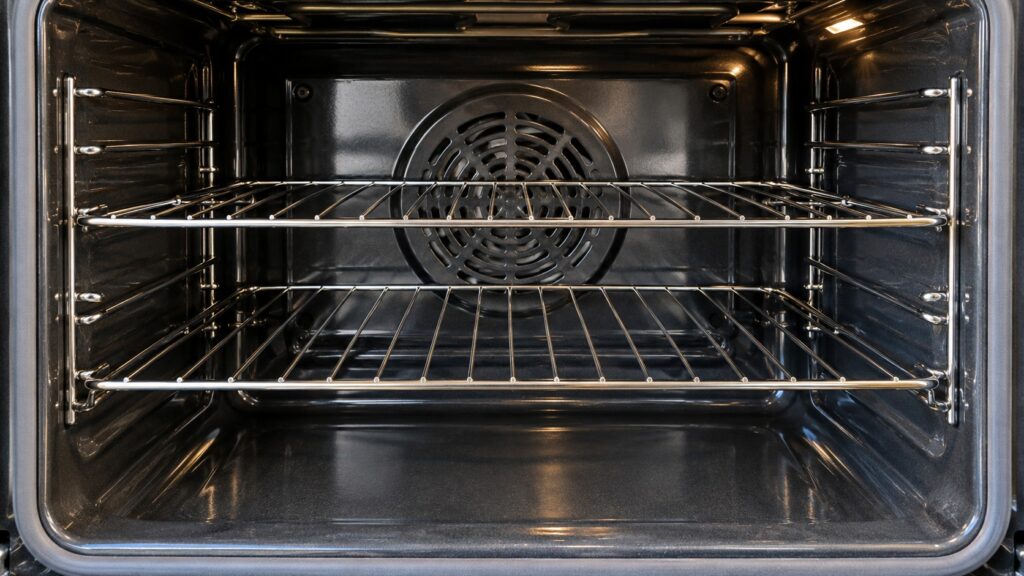
Pyrolytic cleaning heats the empty oven far above normal baking temperature so that food residue turns to ash, which you wipe away afterward. The model list marks it as present on supporting models. During the cycle the door is locked by a motorized latch and stays locked until the cavity has cooled, so a door that will not open right after a cycle is usually normal, not broken. Remove racks and any loose items first, and ventilate the kitchen because the cycle can produce smoke and odor.
Two fault codes are tied to this cycle. F2 is an over-temperature during a pyrolytic clean, and F7 is a door-lock failure that often shows up after one. Both are technician-level, and our pages on the F1, F2 and F3 oven codes and the F4, F5 and F7 oven codes explain what each means.
Which fault terms will you hear from a technician?
A handful of words come up again and again. The electronics bay is the compartment that holds the control electronics, and its cooling fan keeps it below a safe temperature; F1 reports that it got too hot. The power module is the main control board, and F4 points to it, while F5 is a communication fault between the clock module and the power module. The high-limit thermostat is the safety device that cuts power if the cavity runs far too hot, and an RTD sensor is the probe that tells the control the actual cavity temperature. A drifting RTD is a common reason an oven bakes hotter or cooler than set.
When an F-code appears, write it down before you reset anything. The oven may clear on its own after a power cycle, but a code that returns is information a technician can use. Never open the electronics bay or the back of the oven yourself, since it holds mains voltage. If the temperature is merely off, try our guide to calibrating oven temperature first.