An F4, F5 or F7 on a Fisher & Paykel wall oven or range display are three different faults inside the same control system, and mixing them up wastes a service call. F4 points at the power module itself, F5 is a communication failure between the clock module and the power module, and F7 is a door-lock fault — the mechanical lock is jammed or a lock switch or sensor has failed. None of the three is a heating-element problem, and none of them is the F1, F2 or F3 family covered on our F1, F2 and F3 error code guide. This guide reads the fisher paykel oven f5 error and its two neighbors the way the control board actually reports them, so you replace the right part instead of the wrong one.
What does the fisher paykel oven f5 error actually mean?
F5 is not a temperature fault and it is not the clock module failing on its own — it is the two control boards losing the conversation between them. The clock module is the board behind the display and touch keys; the power module is the board that actually switches power to the elements. They exchange signals continuously so the display can show an accurate status and the oven can respond to a button press. When that exchange breaks down, the control raises F5 rather than guessing which side is at fault. That distinction matters because it tells you the problem is almost never the heating elements themselves.
Is F4 a heating-element fault or a control-board fault?
F4 is squarely a power-module fault. The board reports a problem with its own circuitry — not with an element, a sensor, or a wiring connection out in the cavity. A power surge, a failing relay on the board, or a component that has simply reached the end of its life are the usual causes. Because the fault sits on the board rather than downstream of it, cleaning contacts or reseating a sensor plug will not clear it. If cycling power at the breaker for two minutes does not clear F4 and it returns immediately on the next heat cycle, the power module itself needs to be tested and very likely replaced.
Why does F7 mean the door will not confirm locked or unlocked?
F7 lives entirely in the door-lock circuit. A self-clean oven locks its door mechanically before it will run the high-temperature cycle, and a switch or sensor near the latch reports that state back to the control. F7 appears when that report never arrives — the latch mechanism is physically jammed, the switch has failed, or the sensor wiring has come loose. This is one of the few codes on this list you can sometimes clear yourself: check that nothing is obstructing the latch mechanism at the top of the door opening, and confirm the door is closing fully and squarely in its frame. If the latch moves freely by hand but the code persists, the switch or sensor is the likely part, not the latch itself.
Can cycling the breaker clear any of these three codes?
Yes, and it is worth trying before anything else. Cut power at the breaker for a full two minutes, then restore it and run a short bake cycle. A latched fault — one the board is holding in memory from an earlier event — often clears completely. A fault that returns on the very next heat cycle is reporting a live condition, and that is the signal to stop testing and book a diagnostic visit rather than keep power-cycling the oven.
What should you check yourself before calling for service?
- Note the exact code and when it appears. F4, F5 and F7 point at different components, so the exact reading — not “an F-code” — is what a technician needs on the phone.
- Power-cycle once. Two minutes at the breaker, then one short bake cycle to see if the code returns immediately.
- For F7 only, look at the door. Confirm nothing is caught in the latch mechanism and the door seats flush when closed.
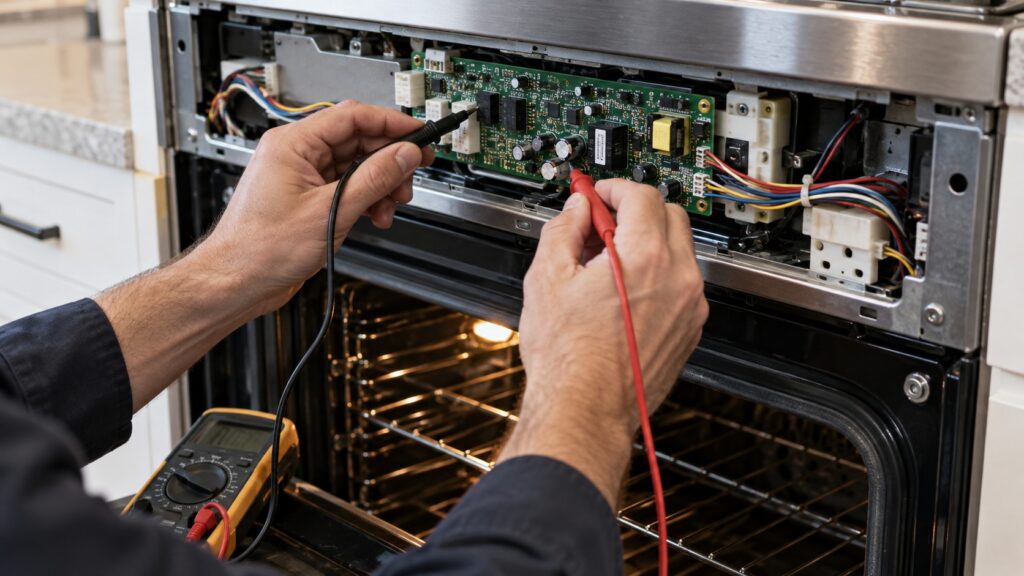
- Stop before opening the control panel. The clock module, power module and their wiring sit close to line voltage, and testing them safely needs a meter and the power confirmed off at the breaker, not just at the wall switch.
Why do F4 and F5 look similar but need different parts?
Both codes point at the electronics rather than the heating elements, which is why owners often assume they are the same issue. They are not. F4 says the power module has a fault in itself; F5 says the power module and the clock module cannot exchange signals, which can be caused by either board or by the wiring harness between them. A technician diagnosing F5 tests the harness and both boards before replacing anything, because replacing the power module alone will not fix a harness fault, and replacing the clock module alone will not fix a power-module fault. Ordering a part from the code alone, without that check, is how a repair ends up needing a second visit.
When does one of these codes mean it is time to call for service?
Any of the three codes returning immediately after a power cycle, rather than clearing, is the point to stop self-diagnosing. F4 and F5 both involve boards that are not safely swapped without confirming which one has actually failed, and F7 involving a door that will not confirm locked can leave a self-clean cycle unable to start or unable to finish safely. Our technicians carry the diagnostics to test the clock module, the power module and the connecting harness on-site, and we are an independent repair company, not a factory service arm — we will tell you plainly when a board is worth replacing and when the oven has reached the point where a repair no longer makes sense against its age. Pricing starts from a diagnostic visit and we confirm the estimate before any work begins.
If your oven is showing F4, F5 or F7 right now, our Fisher & Paykel oven repair service covers all three, and you can schedule a visit with the exact code in hand. For the separate F1, F2, F3 family, see our other oven error code guide, and if the oven has been slow to heat alongside the code, our oven heating problems guide covers that symptom on its own.