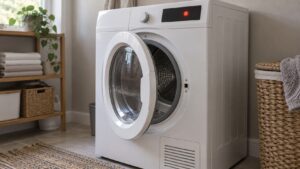
What Airflow Restricted means (fisher paykel dryer airflow restricted)
When fisher paykel dryer airflow restricted is the issue, it is an observable condition that can trigger code 16 — air is not moving freely through the dryer. A clogged lint filter or a blocked exhaust duct is almost always the cause, and clearing both restores airflow.
Symptoms of a fisher paykel dryer airflow restricted problem
Restricted airflow shows up in how the dryer feels and behaves rather than in any single dramatic sign. The cabinet often runs noticeably hot while clothes stay slow to dry, and the outside vent flap may barely move when a cycle is going. Reading these clues together — and checking whether code 16 has appeared — tells you the heat is fine but the air is trapped.
- Drying is slow and the dryer runs hot
- A code-16 warning may appear
- The outside vent flap barely opens
- Lint is visible in the filter or duct
Likely causes
Trapped airflow almost always traces to a single restriction somewhere between the lint filter and the point where the duct exits the house. Checking each link in that path in turn — filter, duct, outside termination, then the shape of the flexible run — usually reveals the blockage without any need for tools.
- Clogged lint filter — the first thing to check
- Blocked exhaust duct — lint buildup
- Blocked vent termination — the outside vent is obstructed
- Crushed ducting — flexible duct is pinched
What you can check
Follow the air’s own route when you check: start at the filter, move to the duct, then confirm the outside flap swings open freely. Each step clears one possible choke point, and noting which one was blocked saves time if airflow stays poor and a technician has to inspect the full path. Avoid disconnecting anything beyond the exhaust duct or touching internal wiring — that is work for a qualified technician.
- Clean the lint filter thoroughly.
- Disconnect and clear the exhaust duct.
- Confirm the outside vent flap opens freely.
- If airflow stays poor, book service.
Parts a technician may check or replace
Depending on what the diagnosis shows, a technician may inspect, test, or replace the lint filter, exhaust duct, vent termination, and ducting. The correct part for your Fisher & Paykel Dryer is matched from the model and serial number, and genuine components are fitted through trusted parts suppliers rather than generic substitutes so that performance, safety, and the appliance’s long working life are all protected. Confirming the failed part before ordering avoids replacing more than the problem actually requires.
When to call a technician
Restricted airflow that persists with a clean filter and duct needs a technician to inspect the airflow path. When the fix calls for trained service, book a visit through our scheduling page and an experienced, qualified technician will diagnose and repair it.
Prevention and care
Airflow restrictions return whenever lint is allowed to settle, so the surest prevention is clearing the filter after each load and running a brush through the full exhaust line once or twice a year. Make sure the duct behind the dryer is not crushed against the wall, and check that the outside vent flap is free of nests or debris. Stick to the Fisher & Paykel guidance for your model, and if drying ever slows again, note how hot the cabinet was running so a technician knows the heat is working and the air path is the place to look.
Related help and Fisher & Paykel resources
Browse other Fisher & Paykel Dryer diagnostics, read about Fisher & Paykel Dryer repair, look up your unit in the Fisher & Paykel models reference, or the related Code 16 airflow restriction, browse service locations, or schedule a service visit. For Fisher & Paykel manufacturer documentation and model lookup, visit Fisher & Paykel at fisherpaykel.com/us.