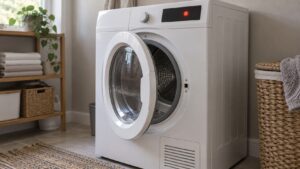

This glossary entry has heat pump dryer explained in plain language by the experienced Fisher & Paykel technicians at our independent repair service. A heat pump dryer is a clothes dryer that uses a refrigeration cycle (compressor, condenser, evaporator) to heat air and remove moisture, instead of a traditional electric heating element. It recirculates air in a closed loop — no external exhaust vent is required. Fisher & Paykel, the New Zealand brand founded in 1934 and now part of Haier, builds its Series 9 heat pump dryers around this principle.
For a complete technical explanation, see our guide: How Fisher & Paykel Heat Pump Dryers Work.
Key characteristics
- No external vent needed — The dryer condenses moisture internally and drains it to a tank or plumbed drain. Install anywhere with a power outlet.
- Lower operating temperature — 130-150°F vs. 180-210°F for conventional dryers. Gentler on fabrics, less shrinkage.
- 28% less energy — Moves heat rather than generating it. Lower utility bills over the dryer’s lifespan.
- Longer cycle times — 90-120 minutes vs. 45-60 minutes for conventional. The lower temperature requires more time.
- 120V operation (Fisher & Paykel) — Fisher & Paykel Series 9 heat pump dryers run on a standard 120V outlet, unlike conventional dryers that need 240V. This simplifies stacking installation.
When to choose a heat pump dryer
- No exterior wall access for venting (apartments, condos, interior rooms)
- Stacking in a closet where vent routing is impractical
- Energy efficiency is a priority
- Fabric care matters (premium clothing, delicates)
Maintenance differences
Heat pump dryers have a condenser that needs periodic cleaning (some Fisher & Paykel models self-clean). The drain tank must be emptied after every 1-2 loads unless plumbed to a drain. See our heat pump dryer maintenance guide.
Repair implications
The heat pump system (compressor, refrigerant) is more expensive to repair than a simple heating element. Compressor replacement starts from $450 vs. from $200 for a heating element. However, heat pump dryers have fewer thermal stress failures because they operate at lower temperatures. See our dryer repair cost guide.
Related terms
- Condenser dryer — A broader category that includes heat pump dryers. All heat pump dryers are condensing dryers, but not all condensing dryers use heat pumps (some use electric heaters).
- Ventless dryer — Any dryer that doesn’t require an external exhaust vent. Heat pump dryers are the most common ventless type.
- AutoDry — Fisher & Paykel’s moisture sensor system that stops the cycle when clothes reach the selected dryness level.
Heat pump dryer explained: choosing and servicing yours
Knowing how the refrigeration loop inside a heat pump dryer behaves makes it far easier to spot when something is genuinely wrong versus simply slow by design. The long, low-temperature cycles that define this technology are a feature, not a problem, so judge performance by whether loads finish dry rather than by how quickly they finish. If a Fisher & Paykel Series 9 dryer suddenly stops drying, leaves clothes warm but damp, or trips an error code, the compressor circuit or condenser airflow is the place to start. Compressor and refrigerant work is delicate and sits well beyond a typical DIY repair, which is exactly where a specialist hand pays off.
Before any service call, jot down the model and serial number from the rating plate inside the door or on the rear panel — heat pump components are tightly matched to specific Series 9 builds, and the correct part number depends on those digits. Our independent technicians source replacement compressors, condensers, and sensors through trusted parts suppliers and back every job with a 30-day labor warranty. If your dryer is showing a problem on the display, our error code reference can tell you whether it is a quick airflow fix or a sealed-system problem worth booking. When the heat pump itself is involved, schedule professional service rather than risking the refrigerant circuit yourself.