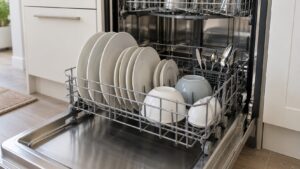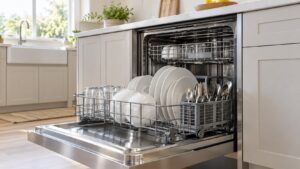
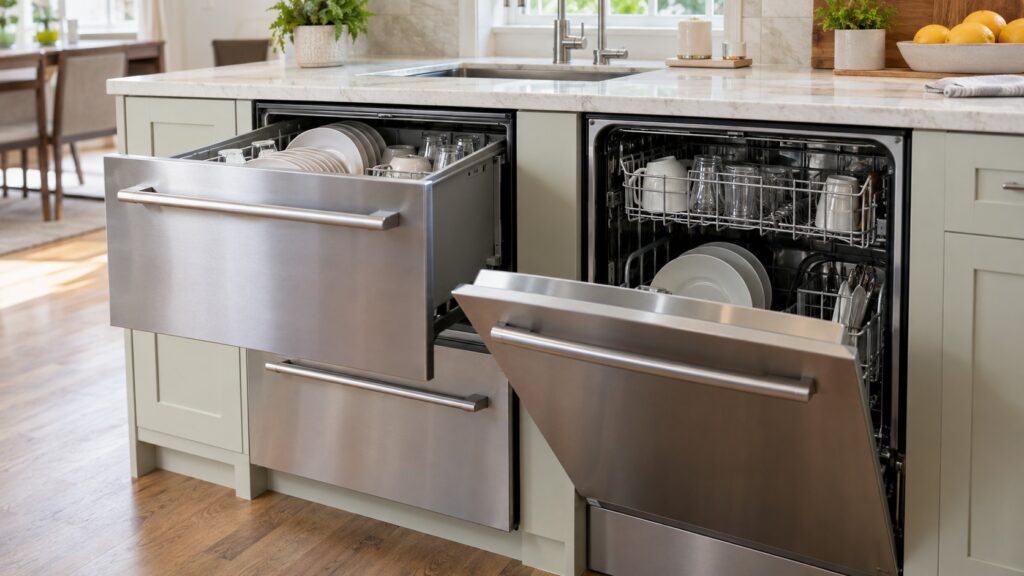
The fisher paykel vs bosch dishwasher decision comes down to format before brand: a Fisher & Paykel DishDrawer is a drawer you pull toward you, while a Bosch built-in dishwasher is a conventional tub behind a hinged door. Most of what separates them in daily life comes from that shape, not from the badge. This guide compares them on the things you can check yourself, using what we see on our service calls for Fisher & Paykel and only the basic format of a Bosch built-in; for any feature of a specific Bosch model, check that model’s own spec sheet.
Is a Fisher Paykel dishwasher better than a Bosch?
Neither is better in the abstract. Both brands sell built-in machines, and both wash dishes properly when installed and maintained. The honest answer is that a Fisher & Paykel suits a household that runs partial loads or wants two programs at once, and a Bosch-style single tub suits a household that washes everything after one big meal. We do not rank brands, and we do not quote reliability numbers for either one, because we have no source we could stand behind.
If your real question is drawer versus door, our guide to the Fisher Paykel DishDrawer vs dishwasher goes through that trade-off in more detail than this comparison does.
How does the drawer format change daily use?
A DishDrawer is not a dishwasher with drawers in it. On a double unit, each drawer is a complete machine with its own motor, its own water path and its own lid that seals it shut. You can run the top drawer daily and the bottom one twice a week, run different programs in each, or run both. A Bosch built-in has one tub, one door and one cycle at a time. That is simpler to understand, and it handles a full load in one go.
The trade-off shows up when something goes wrong. On a drawer unit, a fault usually belongs to one drawer, so the other keeps working. On a single tub, a fault takes the whole dishwasher out of service until it is fixed. Neither is a reason to buy or avoid either brand, but it is worth knowing before you choose.
Which one handles big items and full loads better?
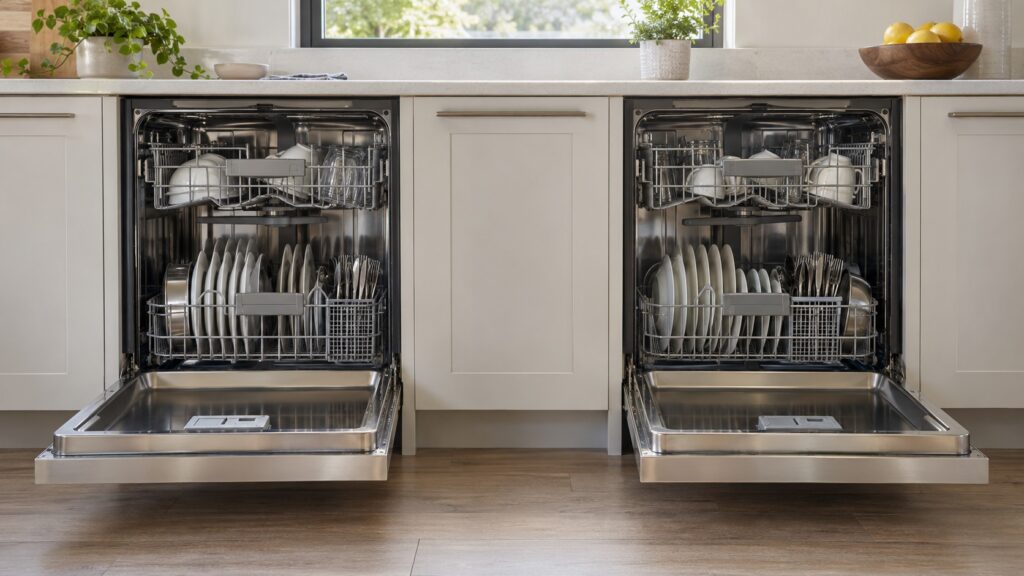
A conventional single tub is the safer pick for tall and bulky items such as stockpots, roasting pans and oven racks, because a deep tub with a pull-out rack has room that a drawer does not. A double DishDrawer holds a comparable amount overall, but split across two smaller spaces, and anything that does not fit the depth of a drawer ends up washed by hand. Measure your largest regular pan, and take the tape measure to the showroom, before you decide.
How do drying and noise compare?
Drying is a place where you should read the spec sheet for the exact model, because both brands sell several tiers with different drying systems. On our side, Fisher & Paykel drawers rely on residual heat from a hot final rinse, and our guide to fan-assisted drying explains what the upper tiers add. Light plastics are the usual complaint with any residual-heat system, whatever the brand, because they hold almost no heat. For a Bosch, check the drying method listed for the specific model rather than assuming it.
Noise is the same story. Both brands publish decibel ratings for each model, and those numbers are measured under different conditions, so compare them on one spec sheet at a time. In an open-plan kitchen, remember that a drawer unit running two short cycles through the evening can be more noticeable than one longer cycle that runs while everyone is out of the room.
What should you check before buying either brand?
Run through a short checklist at the showroom. Load a real pan and a real tall glass. Pull out the filter and see how easy it is to reach, because a clogged filter is behind most poor-cleaning complaints on any dishwasher. Look at how the rack adjusts. Ask about the opening size, supply, drain and power requirements, which are set out for our units in the Fisher Paykel dishwasher installation requirements. If you are replacing an old machine, measure the cabinet opening before you look at brochures, because a single drawer needs a half-height opening, which usually means cabinetry work.
Then think about maintenance. A drawer unit has two filters and two of most parts, so there is more to look after, and the drawer that gets the dirty pans needs its filter cleaned more often. Our guide to cleaning your Fisher Paykel dishwasher filter shows the routine.
Is it worth repairing an older machine instead of switching brands?
Often, yes, if the tub and cabinet are sound. A failed pump, valve or seal is usually a part swap that costs far less than a new dishwasher plus installation. A technician visit makes sense when a drawer will not fill, will not drain or reports a fault code that comes back after a reset. Diagnosis before shopping saves more money than any feature comparison. Our repair or replace guide for a dishwasher sets out when replacement is the better call, and our Fisher Paykel dishwasher repair page explains what a visit covers.