
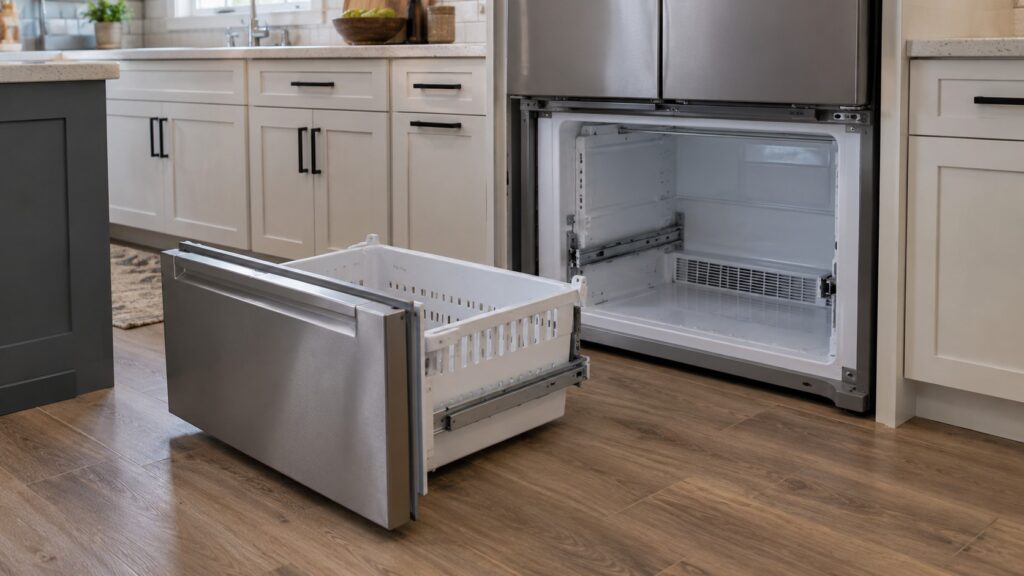
Fisher Paykel freezer drawer removal is a cleaning job you can usually do yourself with the contents out and the drawer lifted out, but the exact release differs from one model to the next, so your owner’s manual decides the method. This guide covers what is common to most fridge and freezer drawers: how to prepare, what to look for when a drawer sticks, how to clean the drawer and the cavity it leaves behind, and when to stop and call a technician. We do not publish the release mechanics for every model, and we would rather say so than describe a latch that your unit does not have.
How do you remove a Fisher Paykel freezer drawer safely?
Start by preparing, not pulling. Move the frozen food to a cooler or another freezer and keep the door of the freezer closed as much as you can, so the cabinet does not warm. If the drawer holds a lot of weight, ask someone to help. A full drawer is heavy and awkward, and an empty one is still bulky, so put a towel or a piece of cardboard on the floor where it will rest. Then open the drawer fully and read the removal steps in your owner’s manual. Do whichever release your manual describes, and do not improvise with a screwdriver.
Take your time and lift evenly, with a hand on each side, so the drawer does not twist on its runners. If anything resists, stop. A drawer that does not come free usually has a latch you have not found, or something is jammed behind it, and forcing it can bend the runners or break a plastic guide.
Why is a freezer drawer stuck?
A stuck drawer is the most common reason people search for removal in the first place. The usual causes are simple. Overfilling is the first: a box of frozen food standing above the fill line catches the front or the back and stops the drawer closing. Frost or ice on the runners is the second, because moisture that gets in around a poor seal freezes the sliding surfaces. A third is a spill that has dried and glued a runner. Check the contents, the rails and the front of the drawer before you assume a fault. Our guide to the CoolDrawer usage tips explains why a drawer left a fraction of an inch open looks shut and quietly loses temperature.
If the drawer is frozen to its guides, do not chip at the ice. Empty it where you can, leave the drawer open for the ice to soften, and wipe it dry. Our guide on how to defrost and maintain a Fisher Paykel freezer shows the safe way to remove frost without tools that can puncture a liner.
How do you clean the drawer and the cavity?
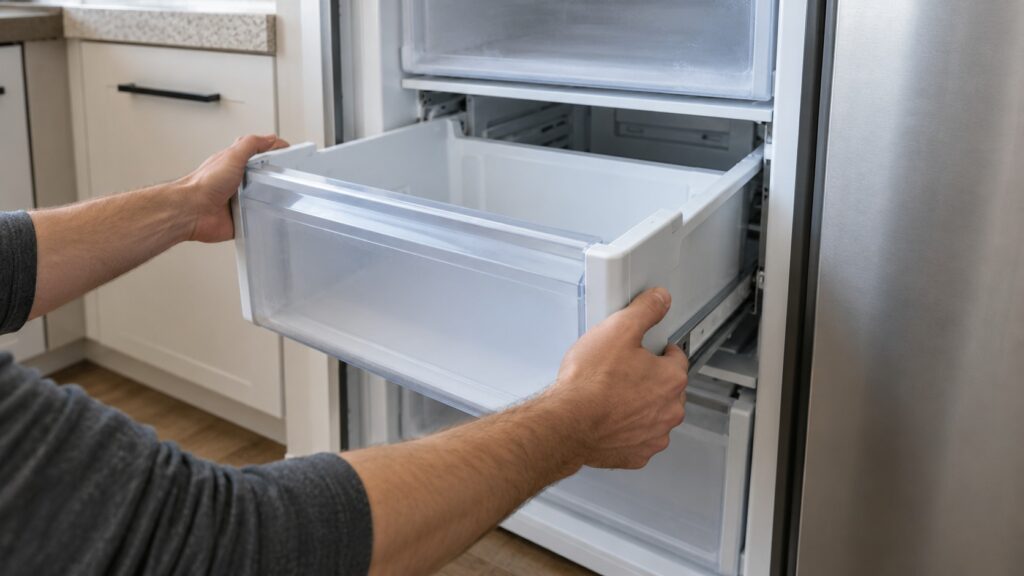
With the drawer out, wash the bin with warm water and a little mild soap, rinse and dry it completely. Do not use abrasive pads or strong solvents on the plastic, because scratches trap grime and harsh chemicals can crack it. Wipe the runners and rails with a damp cloth and dry them, then look into the cavity. You will often find crumbs, ice crystals and a film of old spills. Wipe the walls and the floor of the cavity and the front seal, then dry everything. Keep the cloth away from any electrical parts, and do not spray cleaner into the cabinet.
While you are there, look at the gasket. A cracked or dirty gasket lets in warm, humid air, and that is how frost builds up. Wipe it clean and check that it seals evenly. If you see frost that returns quickly after cleaning, read our page on freezer frost buildup.
How do you refit the drawer?
Reverse the removal steps from your manual. Make sure both sides engage their runners at the same time, then slide the drawer closed slowly and check that it moves smoothly and shuts squarely. Load the contents again below the fill line, and spread the heavy items so the drawer does not tilt. Give the freezer time to recover, because the cabinet will have lost some cold while the drawer was out, and check the temperature after several hours. If the drawer feels rough, jams or will not seat, take it out again and check that both sides are in their guides rather than forcing it.
If the freezer takes a long time to recover, or the temperature alarm sounds, our guides to freezer temperature settings and the freezer high temperature alarm will help you decide whether it is normal.
What about refrigerator drawers and crispers?
The same principles apply to the crisper and other fridge drawers: empty first, follow the manual’s release, wash with mild soap and warm water, dry and refit. The difference is that glass shelves above and covers on crispers can be heavy and slippery when wet, so handle them with care and with both hands. Do not wash glass in very hot water straight from a cold fridge, because a sudden change in temperature can crack it.
When should you call a technician?
Call if the drawer will not close squarely after you have cleared the contents and the runners, if a runner or guide is bent or broken, if the freezer is warming after the drawer is back in place, or if you find water or heavy frost behind the drawer that you cannot account for. A technician can replace guides and test the cooling system. Our Fisher Paykel freezer repair page explains how a visit works.