
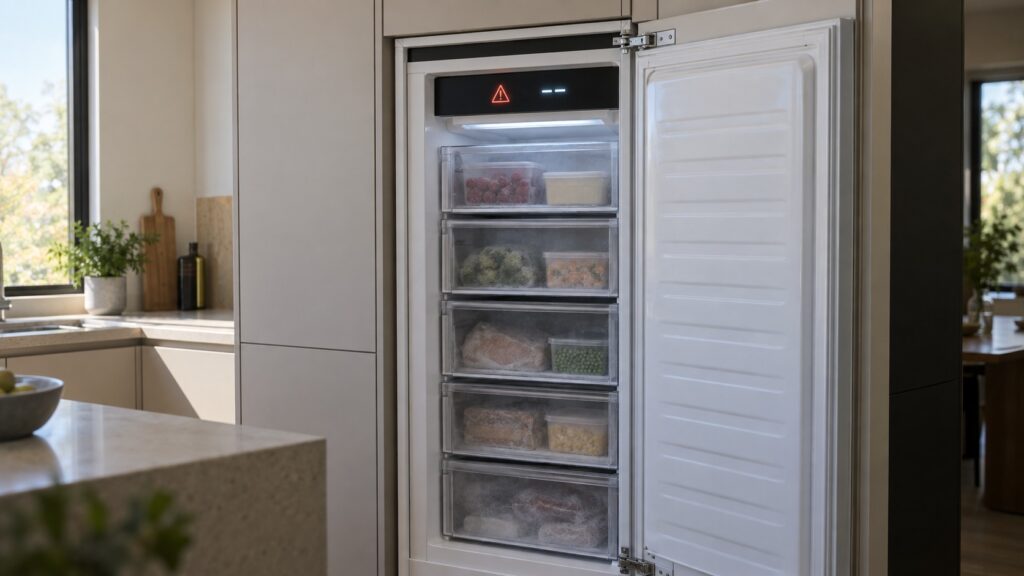
A Fisher Paykel freezer high temp alarm is the appliance telling you that the compartment has been warmer than its setpoint for long enough to matter. It is a warning about the food, not a diagnosis of a part. The first thing to establish is whether you are hearing a door alarm or a temperature alarm, because one of them clears in seconds and the other means the freezer has been losing ground for hours.
Door alarm or temperature alarm — how do I tell them apart?
Close the door firmly and wait thirty seconds. A door alarm stops. A high-temperature alarm does not, and on an ActiveSmart panel it keeps a warning icon or a flashing temperature reading visible after the beeping is muted.
If the beeping stops only when you press hard on the door, the alarm was correct and the door was not closing. That points at a seal that has taken a set, a drawer or basket that is a fraction too far forward, or a cabinet that has shifted out of level so the door no longer falls shut. On a column freezer, a single overfilled basket is enough to hold the door open by the fraction of an inch it takes.
If the alarm continues with the door firmly shut, the compartment is warm and you need to find out why. Note the temperature the panel is showing before you do anything else — it is the most useful number a technician can be given.
Is this alarm normal after a big grocery load or an outage?
Sometimes, and it is worth ruling in before assuming a fault. A freezer that has just taken twenty pounds of room-temperature food is being asked to remove a lot of heat at once, and the compartment average can sit above setpoint for an hour or more while it does. The same is true after a defrost cycle, after the door has been open during a long cleanout, and after a power outage of any length.
The test is time. A freezer working normally pulls back to setpoint and clears the alarm by itself, usually within two to four hours of the door staying shut. An alarm still showing the next morning is not a loading artifact — something is limiting the freezer’s ability to hold temperature, and continuing to wait only costs food.
Food safety runs on its own clock, independent of the appliance. Food that still holds ice crystals and feels hard has stayed cold enough to refreeze. Food that has softened through has not, and no alarm reading changes that judgment.
What actually makes the compartment warm up?
Once loading and door problems are ruled out, the causes fall into a short list, and they are worth knowing in order of how often they turn up.
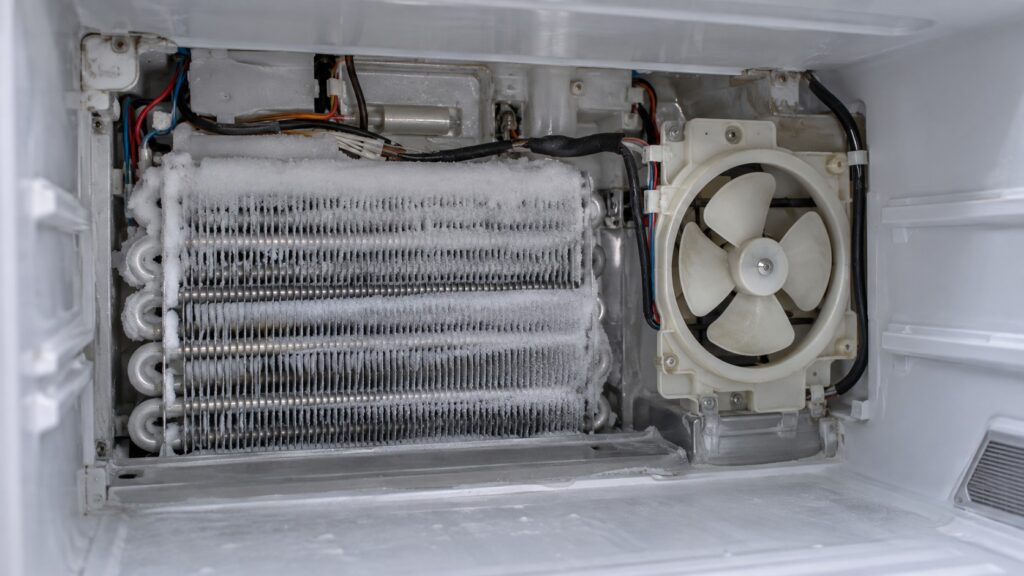
- A stalled evaporator fan. The compressor runs, the evaporator gets cold, and nothing moves that cold air into the compartment. This is what error code 17 describes, and the clue is a freezer that is bitterly cold in one spot and warm everywhere else.
- Frost on the evaporator. A defrost system that has stopped working lets the coil ice over until air can no longer pass through it. The symptom builds over weeks rather than appearing overnight.
- A door seal that leaks. Warm room air entering continuously both raises the temperature and feeds the frost problem above.
- Restricted airflow inside. Boxes pushed hard against the rear vents block the air path the fan depends on.
- Blocked condenser airflow outside. An integrated column relies on a ventilation path through the cabinet plinth and top. If that path is blocked, the whole system loses capacity in warm weather first.
Our guide on a freezer that is not freezing walks these in detail, and defrosting and maintaining the freezer covers the frost case specifically.
Can I silence the alarm without hiding the problem?
You can mute it, and on most ActiveSmart panels a single press of the alarm or temperature pad does exactly that. What you should not do is mute it and walk away. The mute silences the sound; the warning icon stays until the compartment recovers, and that icon is the part worth watching.
Before muting, do four things that take two minutes together:
- Write down the displayed temperature. It is the only record of how far the compartment drifted.
- Check the door seal. Close the door on a dollar bill at several points around the frame. If it slides out with no drag anywhere, the seal is not doing its job.
- Look at the setpoint. A setting nudged while cleaning explains a surprising number of alarms. Our freezer temperature settings guide gives the ranges to expect.
- Feel the rear wall. A thick even layer of frost behind the baskets is a defrost problem rather than a loading one.
Leave the rear panel, the fan and the defrost heater alone. That panel sits directly over the evaporator, the heater is mains-powered, and a coil that has been chipped at with a knife or a screwdriver turns a repairable fault into a refrigerant leak.
When does the alarm mean a service visit?
Call when the alarm has not cleared after a full day with the door closed, when it clears and returns every few days, when the panel is showing a spanner symbol alongside it, or when the compartment reads warm while the compressor is plainly running. That last combination in particular usually means air is not moving where it should — a fan, a defrost fault, or a blocked coil — and none of those diagnose themselves from the outside.
We are an independent repair company, not a factory service arm. Pricing starts from a diagnostic visit — from $129 — with the estimate confirmed before work begins. Fisher Paykel freezer repair covers evaporator fans, defrost systems, door seals and control boards on drawer and column freezers, and you can schedule a visit online. Bring the temperature the panel was showing when the alarm started — it saves an hour of guessing.