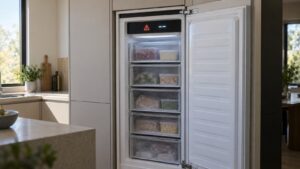

Knowing how to defrost fisher-paykel freezer compartments and keep the key components clean is the simplest way to protect performance and lower running costs. Even frost-free models benefit from routine maintenance of the gasket, coils, and drainage.
How to defrost a fisher-paykel freezer
- Remove all food to a cooler or second freezer.
- Switch the freezer off and prop the door open.
- Place towels at the base to catch melt water.
- Let frost melt naturally — never chip it off with sharp tools.
- Wipe the interior dry, restore power, and let it reach temperature before reloading.
Routine maintenance tasks
- Clean the door gasket and check it seals against a sheet of paper
- Vacuum the condenser coils every few months
- Keep clearance around the cabinet for ventilation
- Confirm the freezer is roughly three-quarters full for stable temperature
Preventing excess frost
- Cool food before placing it inside
- Avoid leaving the door open longer than necessary
- Check the door closes squarely and the hinges are not sagging
Why maintenance matters
Clean coils and a tight seal let the compressor run less and the cabinet hold temperature more evenly, which extends component life. If frost returns quickly after a full defrost, the defrost heater or thermostat may need attention from a technician.
How often to defrost
Manual-defrost models benefit from defrosting whenever frost reaches about a quarter-inch, typically once or twice a year depending on use and humidity. Frost-free models rarely need a full defrost, but they still reward regular gasket and coil cleaning. Defrosting also gives you a chance to rotate older food to the front.
Frequently asked questions
Can I speed up defrosting? A bowl of hot water inside with the door closed helps, but never use a knife, ice pick, or heat gun — these can puncture the liner or evaporator.
Why does frost keep coming back quickly? Rapid frost usually points to a worn door seal letting in humid air, or a defrost-system problem.
Do I need to empty the freezer to clean coils? No — coil cleaning is external. Only a full defrost requires removing food.
Why regular maintenance pays off
A freezer is one of the few appliances that runs continuously, so small inefficiencies add up over a year. Dust-clogged condenser coils force the compressor to work harder and run longer, raising energy use and shortening its life. A gasket that no longer seals lets humid air in, which both raises the temperature and accelerates frost build-up, compounding the problem. Keeping coils clean, the seal tight, and the cabinet appropriately full lets the compressor cycle less and hold temperature more evenly. Routine care also surfaces small issues — a sagging door, a worn gasket, a noisy fan — while they are cheap to address rather than after they cause a temperature excursion that spoils food. Build the few simple tasks into a seasonal routine, and pair them with a quick thermometer check so you have confidence the cabinet is genuinely holding 0°F (-18°C). If frost or temperature problems return soon after a thorough defrost and clean, that is the signal to have the defrost system and seal inspected by a technician.
When you defrost fisher-paykel freezer compartments and frost still wins
Manual defrosting and routine cleaning solve most frost problems, but they cannot fix a defrost system that has actually failed. The tell-tale sign is frost that smothers the evaporator again within days of a thorough defrost — a pattern that points to a dead defrost heater, a faulty thermostat, or a timer that no longer triggers the cycle. Our experienced technicians test each of those components against expected values rather than swapping them on a hunch, so the repair targets the part that is genuinely keeping the cabinet from staying clear.
When a defrost heater, thermostat, or control proves faulty, the replacement comes from trusted parts suppliers and is matched to your freezer so the automatic cycle runs at the correct interval and the frost stops returning. Every repair is backed by a 30-day labor warranty. We avoid quoting a price before inspecting the unit, since a thermostat and a control board cost very differently; defrost-system service generally starts from a standard call-out and depends on the diagnosis.
Routine defrosting and coil cleaning are safe and worthwhile to do yourself, and we encourage it — but once the automatic defrost system is the suspect, testing the heater and control involves the mains-voltage wiring behind the cabinet, which is best left to a specialist. If frost keeps winning despite a careful defrost, that is the moment to call. You can book online at any time, and we coordinate appointments across all 50 states.
If frost keeps returning despite regular defrosting, our specialist technicians can help — book a repair online 24/7, browse our freezer repair services, or review the related freezer error codes and model specifications. For original product documentation, see the manufacturer site at fisherpaykel.com.