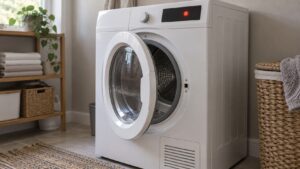
What Not Drying means (fisher paykel dryer not drying)
When a fisher paykel dryer not drying is the problem, it is an observable condition — the cycle runs but clothes come out damp. Restricted airflow (which can show code 16), a heating problem, or an overloaded drum are the usual causes, and cleaning the filter and duct is the first step.
Symptoms of a fisher paykel dryer not drying
Damp laundry at the end of a cycle can come from more than one place, so it helps to pin down exactly what your machine is doing. Some owners notice the problem creep in over a few weeks of slower drying; others see it appear the day after moving the dryer or running a heavy load. Compare what you are seeing against the points below, and the picture of where to look next becomes a lot clearer.
- Clothes are still damp at the end
- Cycles run long without drying
- The lint filter or duct may be clogged
- Code 16 may appear
Likely causes
A dryer that turns but leaves washing wet usually fails at one of a handful of points along the heat-and-airflow chain. Ranking those points from the simplest to check to the ones that need test equipment lets you settle the obvious culprits — lint and overloading — before assuming the heater or sensor is responsible.
- Restricted airflow — a clogged filter or duct (code 16)
- Heating problem — the dryer is not heating
- Overloaded drum — air cannot circulate
- Moisture-sensor failure — the cycle ends early
What you can check
The steps below move from the lint filter outward toward the exhaust, which is the order in which drying problems are most often solved. Jot down what each step shows, because a clean filter and clear duct that still leave clothes wet point straight at the heater or sensor. Leave anything involving the heater wiring, gas, or internal electrical parts to a qualified technician rather than opening the cabinet yourself.
- Clean the lint filter and clear the exhaust duct.
- Avoid overloading the drum so air can circulate.
- Confirm the dryer is on a heated cycle, not air-only.
- If it still will not dry, book service for the heater and sensor.
Parts a technician may check or replace
Depending on what the diagnosis shows, a technician may inspect, test, or replace the lint filter, exhaust duct, heater, and moisture sensor. The correct part for your Fisher & Paykel Dryer is matched from the model and serial number, and genuine components are fitted through trusted parts suppliers rather than generic substitutes so that performance, safety, and the appliance’s long working life are all protected. Confirming the failed part before ordering avoids replacing more than the problem actually requires.
When to call a technician
A dryer that will not dry with clear airflow needs a technician to test the heater and moisture sensor. When the fix calls for trained service, book a visit through our scheduling page and an experienced, qualified technician will diagnose and repair it.
Prevention and care
Most repeat cases of wet laundry come down to lint that quietly builds back up, so the simplest habit is clearing the filter after every load and checking the exhaust run a couple of times a year. Give the drum room to tumble rather than packing it full, keep the area behind the dryer free so the duct is not crushed, and follow the Fisher & Paykel guidance for your model on cycle and sensor-dry settings. If drying ever slows again, make a note of the load size and how warm the air felt — that small detail often tells a technician whether to start at the airflow path or the heater.
Related help and Fisher & Paykel resources
Browse other Fisher & Paykel Dryer diagnostics, read about Fisher & Paykel Dryer repair, look up your unit in the Fisher & Paykel models reference, or the related Code 16 airflow restriction, browse service locations, or schedule a service visit. For Fisher & Paykel manufacturer documentation and model lookup, visit Fisher & Paykel at fisherpaykel.com/us.