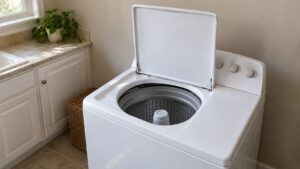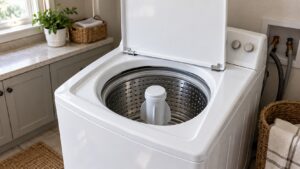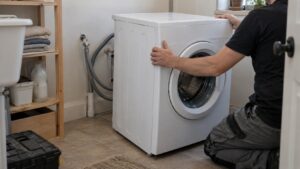
A fisher-paykel washer dryer stack installation is the smartest way to reclaim floor space without giving up full-size laundry capacity. Three things make or break the job: the correct Fisher & Paykel stacking kit, a floor and alcove that can take the load, and utility connections that match each unit. Plan all three before you start lifting, and the result is a tidy, stable tower that runs as quietly stacked as it would side by side.
Stacking kit
You must use the genuine Fisher & Paykel stacking kit (WTZ20410 or model-specific equivalent). The kit includes a metal bracket that secures the dryer to the washer and prevents movement during high-speed spin cycles. Do not stack without it — the dryer will walk off the washer during spin, potentially causing damage and injury.
The washer always goes on the bottom. It’s heavier and has a lower center of gravity. Never reverse the order.
Structural requirements
- Floor capacity — A stacked Fisher & Paykel set weighs approximately 350-400 lbs combined. With a full water load in the washer, total weight reaches 500+ lbs. Standard residential flooring can handle this, but if you’re installing on an upper floor or in an older home, verify the floor can support concentrated weight.
- Height — Stacked Fisher & Paykel compact models (24-inch) reach approximately 68-70 inches total. Full-size (27-inch) stacks reach 74-76 inches. Verify ceiling clearance, accounting for any overhead cabinets or soffits.
- Alcove depth — Minimum 25 inches for compact models, 29 inches for full-size. Add 2-4 inches for hose connections behind the units.
Electrical
- Washer — 120V, 60Hz, 20A dedicated circuit
- Dryer (conventional) — 240V, 60Hz, 30A dedicated circuit with a 4-prong outlet (NEMA 14-30)
- Dryer (heat pump Series 9) — 120V, 60Hz, 15A. This is a significant advantage of heat pump dryers in stacking configurations — no 240V outlet needed. Both units can potentially share a 20A circuit (check local code).
Plumbing
Standard washer connections: hot and cold water supply with shut-off valves, and a standpipe or laundry sink drain at 24-30 inches above the floor. Use braided stainless steel supply hoses — not rubber. Replace hoses every 5 years regardless of condition.
Ventilation
Conventional dryers need a 4-inch exhaust vent to the exterior. Keep the duct run as short and straight as possible — each 90° elbow reduces efficiency. Maximum recommended duct length: 25 feet equivalent.
Heat pump dryers (Series 9) require no exhaust vent. They condense moisture internally and drain through a hose to the same standpipe as the washer, or into a collection tank that you empty periodically. This makes them ideal for closet, basement, and apartment installations where venting is impractical.
Installation process overview
- Position and level the washer
- Connect washer water supply and drain
- Remove shipping bolts from the washer (critical — leaving them in damages the drum suspension)
- Attach the stacking kit bracket to the washer top
- With two people, lift the dryer onto the bracket and secure
- Connect dryer electrical and vent/drain
- Run test cycles on both units
Stacking installation requires two people minimum and takes 2-3 hours. Schedule professional Fisher & Paykel installation if you want the lift, leveling, and connections handled by experienced technicians.
Fisher-paykel washer dryer stack installation: final checks
Before the first real wash, run a short spin cycle and put a hand on the dryer to confirm the bracket is holding it dead still — any rocking means the bracket bolts need another turn. Check that the SmartDrive washer sits perfectly level on all four feet, since an out-of-balance bottom unit transmits vibration straight up the tower. Verify the dryer’s drain or vent path is clear and that nothing pinches the supply hoses against the back wall once both units are pushed into place.
Keeping the stacked pair running well
A stacked tower is harder to pull apart later, so a bit of routine care pays off. Wipe the washer door boot and leave the door ajar between loads to prevent odor, clean the dryer lint filter after every cycle, and on a heat pump Series 9 rinse the condenser filter on the schedule the control prompts. These small habits keep the drum bearings, pumps, and heat-pump components healthy deep into their service life.
If either appliance flashes a problem, our error code reference explains the message before you start disassembling a tightly stacked set. When a repair is genuinely needed, our experienced technicians can diagnose the issue without unstacking unnecessarily, fit parts from trusted suppliers, and quote work starting from $99, backed by a 30-day labor warranty.