
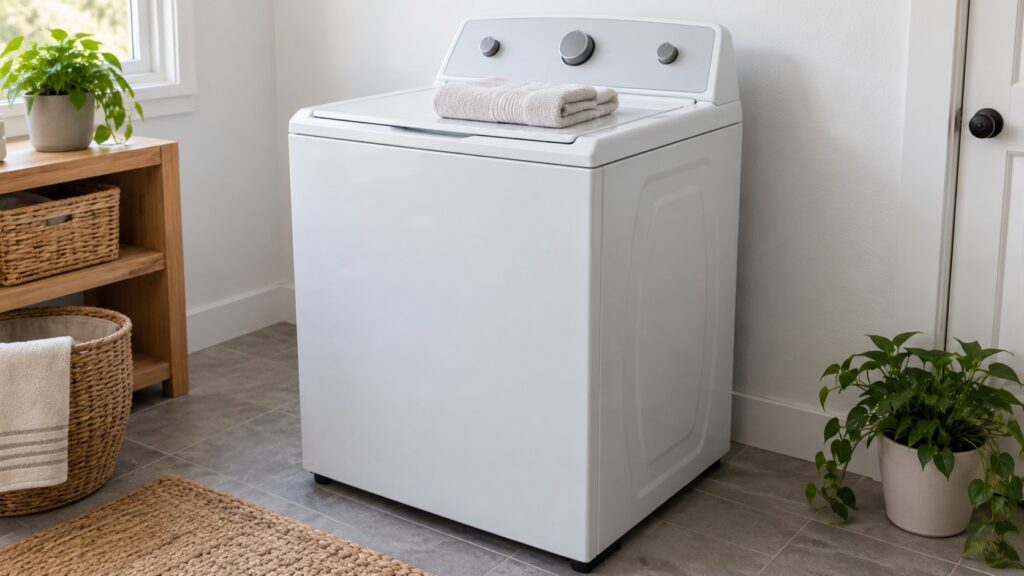
A Fisher Paykel washer installation checklist covers a short job done in a careful order: pick a firm level spot, connect hot and cold water with clean hose filters, secure the drain hose, plug into a grounded outlet, level the machine, and run a first cycle while you watch for leaks. The washers still in use in the US are the GWL and IWL top-loaders and the 24-inch WH front-loaders. They are legacy models that are no longer sold here, so many installs are moves, replacements of a tired hose set or a reinstall after a renovation.
What should you check before you move the washer into place?
Start with the floor. A washer spins a heavy, wet load, and a floor that flexes will make even a perfectly leveled machine shake. A solid slab or a well-supported subfloor is ideal, and a bouncy floor is worth stiffening before you blame the washer later. Clear a path, measure the doorway and the final spot, and leave room behind the machine for the hoses to curve without kinking. A kinked inlet hose is one of the quiet causes of a fill problem.
Check the washer itself while it is still accessible. Read the model number on the rating plate so you know whether you have a GWL or IWL top-loader or a WH front-loader, and keep the owner’s manual nearby. If your front-load model came with transit or shipping fasteners, remove them as the manual describes before you run it, because a washer spun with its drum still locked down can be damaged.
How do you connect the water supply correctly?
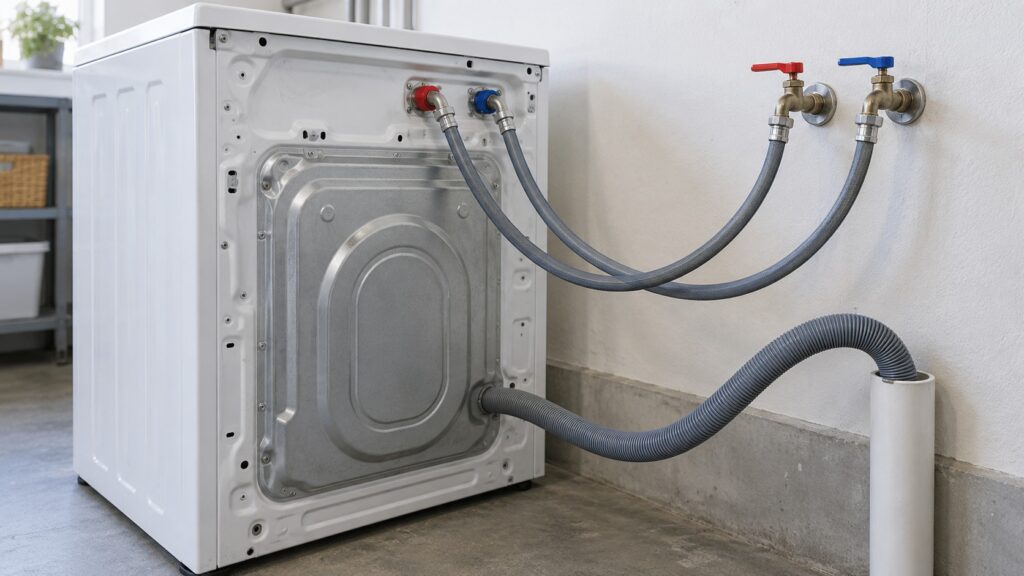
Fisher Paykel washers expect both hot and cold supplies. Fit the hoses hand-tight plus the extra turn the hose maker recommends, and make sure the small mesh filter is seated at each hose end or valve inlet. Those screens catch grit, and they are the first thing to check if the washer is slow to fill later. Open both taps fully and check each connection for weeping with a dry paper towel, because a drip that starts small will rot a floor if it goes unseen.
The washer measures how long it takes to reach the required water level. If it does not get there within about 8 minutes, it stops with a no-water message, which is the well-known no tap error. The usual reasons are a tap that is not fully open, a kinked hose or a clogged inlet screen, so an install that looks correct but skipped one of those steps is the first thing to recheck. Our guide to inlet hose and filter care shows how to inspect them.
Where should the drain hose go?
The drain hose has to carry water out against the pump without letting it flow back or siphon. Route it into a standpipe or a laundry tub and secure it so the end cannot jump out during a spin. Keep the bend smooth and avoid pushing the hose deep into the standpipe, because a tight seal can let water siphon straight through the machine. Check the height and fit against your owner’s manual, since the correct range depends on the model.
A hose that is crushed behind the washer or a standpipe that is partly blocked will show up later as a slow drain. A washer that cannot empty may stop with a pump or drain code, such as code 37 on top-load models, so a clear drain path is part of installing it right.
How do you level the washer and test the first cycle?
Level the machine side to side and front to back by turning its adjustable feet, then tighten the lock nuts if it has them. Push on each top corner: a washer that rocks diagonally still has one foot light. Leveling is the single biggest influence on vibration and noise, and on whether a spin is abandoned for being out of balance. If the washer walks or thumps after you have leveled it, our guide to washer vibration issues goes deeper.
Plug the washer directly into a grounded outlet, not an extension cord or a loose adapter. Then run a short first cycle with no clothes, or with a very small load. Watch both taps and both hose ends for the first few minutes, listen to the fill and the drain, and look under and behind the machine when the spin finishes. Use a small amount of detergent made for your type of washer, because too much will trigger the suds protection and stop the cycle with a Suds Loc message.
What if the washer will be stacked or moved later?
If you plan to place a Fisher Paykel dryer above a front-load washer, the stacking rules are a separate checklist, covered in our guide to washer and dryer stack installation. For any move, shut off both taps, drain the hoses into a bucket, and keep the hose set with the machine so the filters and rubber washers go with it. Replace hoses that look swollen or cracked rather than reusing them, since a failed hose is the most common cause of a flood.
If something is not right after the install, Fisher Paykel washer repair can check the inlet valves and the pump, and the page on washer leaks helps you trace the source of any drip.