Fisher Paykel washer hoses are the cheapest parts on the machine and the ones most likely to cause both a service call and a flooded floor. They sit behind the appliance where nobody looks, they carry mains pressure around the clock, and the little screens inside their fittings silt up slowly enough that nobody notices until a cycle stalls at fill. This guide covers the ten-minute routine that keeps all of that from happening, and how to tell a supply problem from a machine problem.
Why the screens matter more than the hoses
Each inlet fitting has a fine mesh screen whose job is to stop grit reaching the valve. It works, which is the problem: everything it catches stays there. In hard-water areas, or after any work on the household plumbing has stirred up the pipes, those screens silt up and flow drops.
The symptom is gradual and easy to blame on the machine: cycles take longer, the drum fills slowly, and eventually a fill fault appears. That sequence is why the screens are the first thing to check when a machine stalls at fill, ahead of the valve and long ahead of the control — our page on a washer that will not fill follows the same order.
Cleaning the screens, step by step
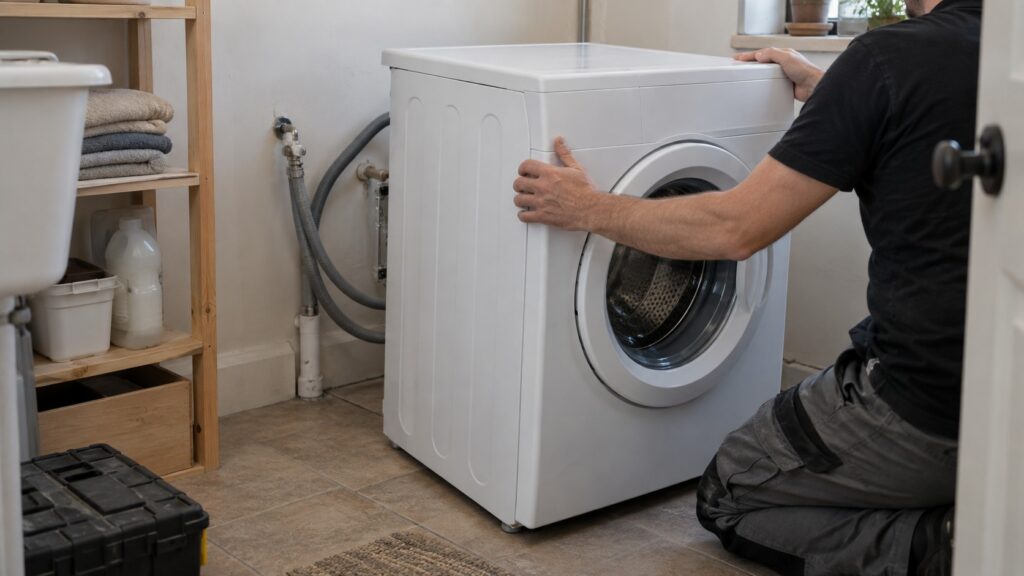
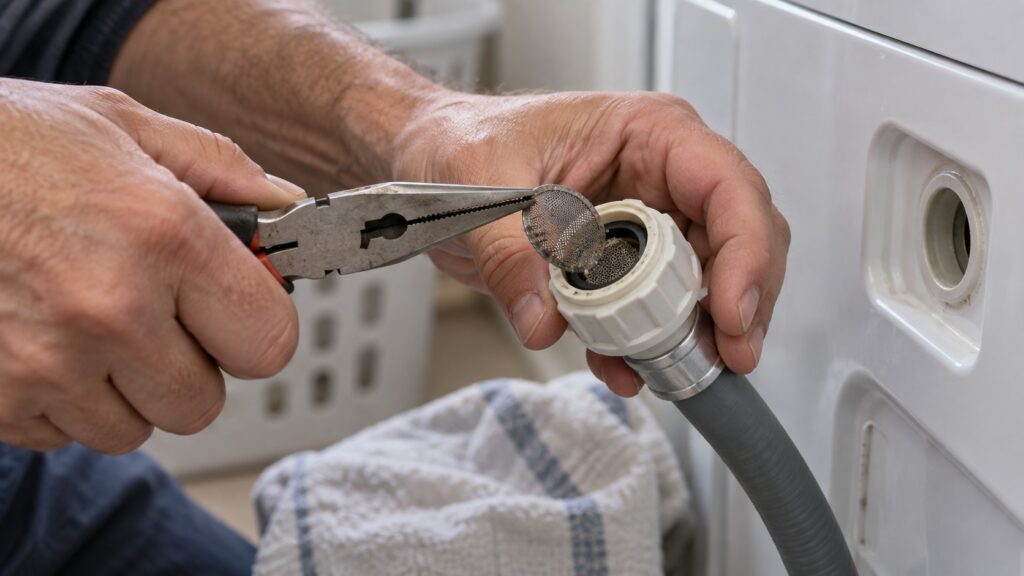
Turn both taps off. Unplug the machine. Put a towel and a shallow bowl behind it, because the hoses hold water. Unscrew the hose at the machine end — by hand if possible, gently with pliers if not — and look into the fitting: the screen is the fine disc just inside.
Ease it out with a fingernail or long-nose pliers, rinse it under running water, and brush it with an old toothbrush if there is scale. Refit it the way it came out, hand-tighten the hose with a quarter turn of pliers, open the taps and watch the fitting for a minute before pushing the machine back. If a screen is torn or crumbling, replace the hose rather than the screen.
Hoses age from the inside
A rubber inlet hose looks fine right up until it does not. The rubber hardens and the reinforcement weakens where it is bent, and the failure — when it comes — happens under full pressure with nobody home. Replacing them every five years is cheap insurance; braided stainless hoses with a five-year date written on them in marker are cheaper than one afternoon of water.
The same rule applies to how they are routed. No tight bends at the fitting, no kinks against the wall, no weight of the machine resting on a hose. Leave a gentle loop so the hose is not pulled straight when the machine is pushed back.
Telling a supply problem from a machine problem
That last one is worth taking literally. When the control reports that a tap is off, it usually means exactly what it says — and our page on a no-tap warning covers the short list of reasons it can be wrong.
The drain side deserves a look too
While the machine is out, check the drain hose: no kinks, securely retained where it enters the standpipe, and not pushed so far down that the machine siphons. The end should sit above the water level of the trap, and the hose should not be a tight coil behind the appliance.
The drain pump filter is a separate routine and a more frequent one — it catches coins, pins and lint before they reach the pump, and our guide on cleaning the drain pump filter covers it. Doing both at the same time makes sense: the machine is already pulled out, the taps are already off and the towel is already on the floor, so the second job costs ten extra minutes instead of a whole second afternoon.
A note on pressure and shared plumbing
Modern washers meter water carefully, so a machine on a weak or shared supply behaves oddly rather than obviously: long fills, cycles that extend themselves, and occasional faults that vanish when the house is quiet. If a machine misbehaves only when the dishwasher runs or when someone showers, the appliance is fine and the plumbing is the conversation.
Fit hoses to the machine’s own taps rather than through splitters where you can, and avoid sharing a single cold feed between a washer and a high-demand appliance. It is a five-minute decision at installation that prevents years of intermittent complaints.
Do not forget the taps themselves. A shutoff valve that has not been turned in ten years often will not turn at all, or will not seal again once it does — and that is discovered at the worst possible moment, with water coming out of a hose. Exercise both valves once a year: close them, open them, and look for a weep at the stem afterward. A valve that resists or drips is a plumber’s ten-minute job today rather than an emergency later.
When to call
Call when a machine still fills slowly after both screens have been cleaned, when a hose or fitting weeps at all, when water appears under the machine, or when a fill fault returns with good household pressure. A weeping fitting is not a small thing behind a machine that sits against a wall, and an inlet valve that will not close fully is a flood in slow motion.
We are an independent repair company, not a factory service arm. Pricing starts from a diagnostic visit — from $129 — with the estimate confirmed before work begins. Fisher Paykel washer repair covers inlet valves, pumps, hoses, sensors and controls on SmartDrive and AquaSmart machines, and you can schedule a visit online.