What E7:03 means (fisher paykel e7:03 error)
A fisher paykel e7:03 error is part of the E7:xx motor-error family on WH front-load washers — E7:03 is a motor over-current problem, meaning the drive drew more current than allowed. The real codes use the colon form rather than a bare “E7.” Over-current usually points at the motor or its control module and is a technician-level diagnosis.
Symptoms that accompany an E7:03 over-current
Where a stall code shows up at the start of rotation, an over-current like E7:03 tends to surface once the drum is already moving and the drive is asked to hold a load. Watch for the moment the problem lands: a sudden stop mid-cycle, or a code that keeps coming back as soon as you reset and restart, both suggest the drive is pulling too much current rather than simply meeting a jam. The pattern of when E7:03 returns is often more telling than any single symptom.
- “E7:03” appears on the front-load display
- The drum may stop suddenly under load
- The cycle aborts
- The problem recurs after a reset
Likely causes of an E7:03 over-current
Excess current on the drive circuit points to one of three things: the motor itself drawing too hard, the electronics that feed it misreading or misdriving the load, or a mechanical drag that forces the motor to work beyond its limit. A short in the motor wiring can produce the same reading. Sorting these by how invasive each is to test is the practical way to approach E7:03.
- Drive motor failure — the motor draws excessive current
- Motor control module failure — the drive electronics problem
- Mechanical binding — a seized bearing increases load
- Wiring failure — a short in the motor circuit
What you can safely check on an E7:03
Owner checks for E7:03 stop well short of the drive electronics — they are limited to feeling whether the empty drum turns smoothly and giving the control one clean power cycle. Resist the urge to keep restarting, because every retry on an over-current problem re-stresses a drive that is already pulling too hard. Note whether the empty drum spins freely; if it does, the problem almost certainly sits in the motor or its module, which is technician territory.
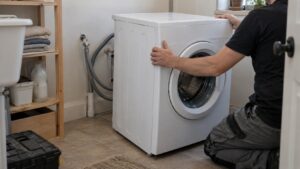
- Switch off, then check the drum spins freely by hand when empty.
- Power off at the wall for a minute, then restore power and retry an empty cycle.
- Avoid repeated retries that re-stress the drive.
- Because over-current points at the motor and control, leave E7:03 to a technician.
Parts a technician may check or replace
An E7:03 work-up centers on the motor, the electronics that drive it, and the harness that carries the current between them. A technician may inspect, test, or replace the drive motor, motor control module, and wiring harness, matching each to your washer’s model and serial number. Genuine parts come through trusted parts suppliers rather than generic substitutes, and pinning down whether the current spike came from the motor, the board, or a shorted lead avoids replacing a healthy component alongside the faulty one.
When to call a technician about E7:03
E7:03 needs a technician to test the drive motor, bearings, and motor control module and replace the failed part. When the fix calls for trained service, book a visit through our scheduling page and an experienced, qualified technician will diagnose and repair it.
Preventing E7:03 from recurring
Because over-current is aggravated by drag and unstable power, the most useful prevention is keeping the drive from ever having to strain. Make sure the washer sits level so the drum is not loaded off-axis, give it a correctly rated and stable supply, and address any new bearing rumble or grinding promptly before it loads the motor down. Steer clear of resetting and rerunning the same heavy cycle when E7:03 has already appeared once. If the code does come up, record exactly what was displayed before you power-cycle the machine — that note helps the technician reach an accurate diagnosis and avoid replacing parts unnecessarily.
Related help and Fisher & Paykel resources
Browse other Fisher & Paykel Washer diagnostics, read about Fisher & Paykel Washer repair, look up your unit in the Fisher & Paykel models reference, or the related E7:01 motor stall, browse service locations, or schedule a service visit. For Fisher & Paykel manufacturer documentation and model lookup, visit Fisher & Paykel at fisherpaykel.com/us.