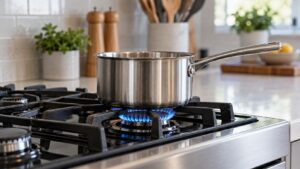
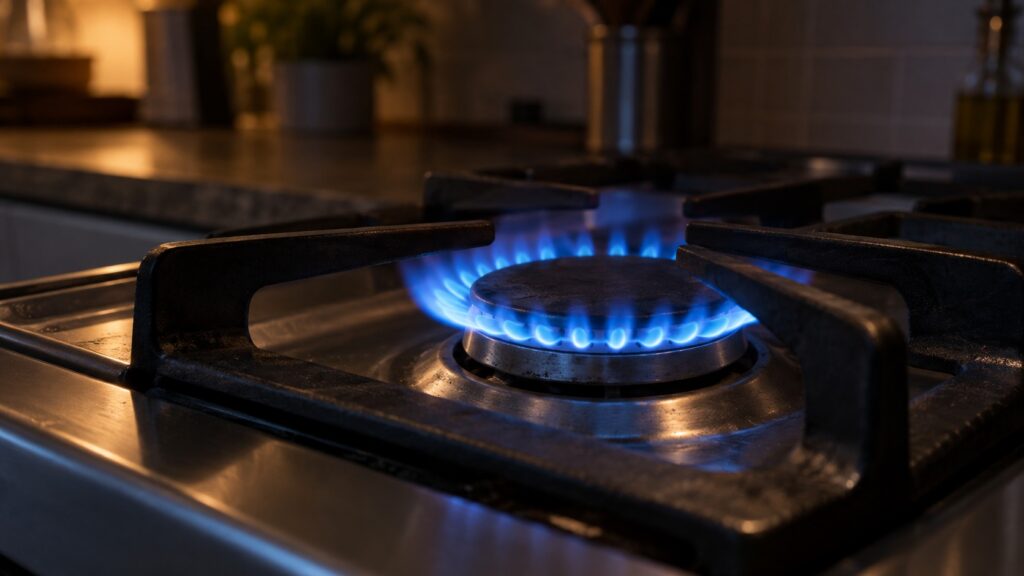
The Fisher Paykel gas cooktop flame failure safety system is a simple idea with an important job: if a burner flame goes out while the gas is still on, the system shuts the gas off at that burner so unburned gas does not build up in the kitchen. It is why a gas burner stays lit only while something is holding its safety valve open, and why the lighting sequence for your cooktop is given in your owner’s manual. Our page on a gas flame that goes out describes the system in terms of a flame-failure device, a thermocouple, the burner and the gas valve. This guide explains how those parts work together and what a failure looks like.
What does a flame failure device do?
It is a safety device that links the flame to the gas supply. Without it, a draft, a boil-over or a gust could put out a burner and leave the gas flowing. With it, the burner’s gas valve stays open only while the device senses that there is a flame. If the flame goes out, the device lets the valve close and the gas stops. Our gas flame goes out page describes it as a symptom-only safety condition, since gas cooktops have no error codes: the thermocouple must sense the flame and hold the gas valve open, and if it does not heat quickly enough, the safety shuts the gas off.
How does the thermocouple fit in?
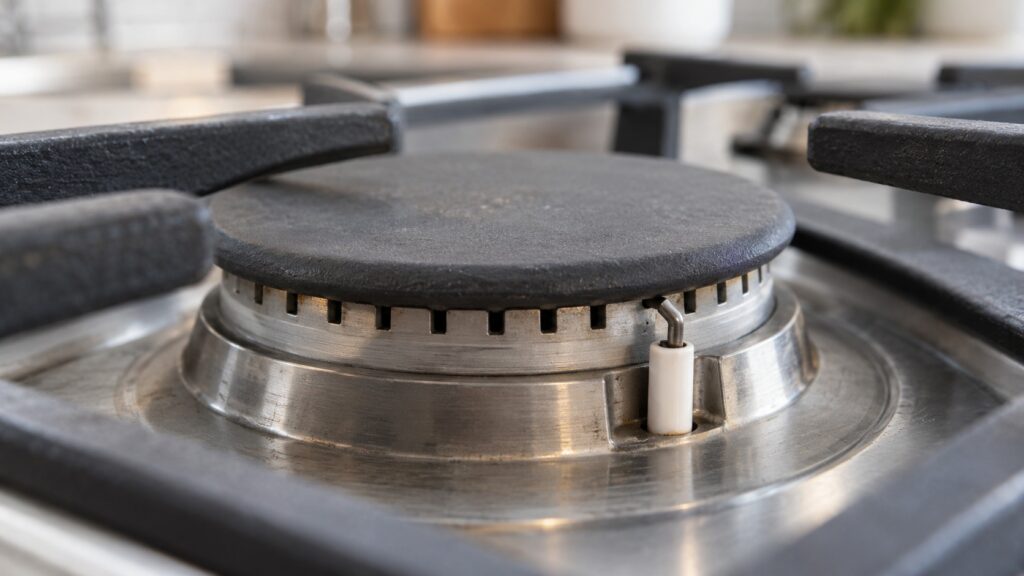
A thermocouple is a sensing element placed in the flame. When it is heated, it produces a small signal that holds the safety valve open. When the flame disappears, the thermocouple cools and the signal fades, and the valve closes. That is why a burner has a defined lighting sequence: the flame needs a moment to heat the sensor before the safety can hold the valve open by itself. The sequence for your cooktop is described in your owner’s manual, and we do not describe the actions or give a number of seconds here.
Why does the flame die right after lighting?
Because the thermocouple has not been heated enough to hold the valve open on its own. Our flame-out page lists the likely causes: a flame that does not reach the sensor because the cap is misaligned or the flame is weak, a dirty or faulty thermocouple that does not sense the flame, clogged burner ports that give a poor flame, or a gas valve that no longer holds open. The pattern is distinctive: the burner lights normally and then goes out soon after you have completed the lighting sequence in your manual, often on one burner only, and frequently after a spill or a cleaning. Each cause is different, and only some are owner-level.
What can you check yourself?
Start with what the burner can tell you. With the burner off and cool, lift the cap and check that it is clean, dry and seated flat, since a cap that has shifted weakens or deflects the flame. Clear the ports gently. Make sure nothing, such as a pan boiling over or a draft from an open window or a hood running at full speed, is blowing the flame away from the sensor. Do not touch, bend or clean the thermocouple yourself, and never try to bypass the safety by taping, jamming or holding the knob in beyond what the manual describes.
What is different between flame failure and a burner that will not light?
Different symptoms, different parts. A burner that clicks and never lights is an ignition problem: a wet or misaligned cap, blocked ports, a weak electrode or a gas supply issue, and the gas burner won’t light page and our burner not igniting guide cover it. A burner that lights and then dies shortly after lighting is a flame-failure problem, because the spark and the burner worked but the safety did not hold. Telling a technician which one you have saves time. If you smell gas at any point, do not turn anything on or off, leave the house and call your gas company or 911 from outside.
Why is it never a good idea to defeat the safety?
Because the device is there for a reason. A burner that stays on without a flame fills the room with gas, and a few seconds of an unlit burner is enough to cause a hazard. If the safety keeps shutting a burner off, the right response is to stop using that burner and have it diagnosed, not to find a way around it. Gas valves, thermocouples and connections are technician jobs, and so is any repair that touches the safety system. Our Fisher & Paykel cooktop repair page explains how a visit works.
How can you keep the safety system working well?
Keep the burner area clean and dry, because most flame-failure complaints begin with a spill, a cleaning or damp parts. Wipe boil-overs once the cooktop is cool, lift and dry the caps after washing them and set them back flat, as our burner cleaning guide describes. Avoid cooking in a strong draft, and run the hood at a moderate speed rather than full blast, since a strong airflow across the burner can disturb the flame. If one burner starts to misbehave while the others are fine, note which one and what you were doing, and keep using only the burners that work normally until it is checked. A written note of the symptom helps a technician decide quickly whether the cause is the flame, the sensor or the valve.