Fisher Paykel cool drawer repair is more often a sensor, seal, fan or control job than a compressor job, and that shapes the repair-or-replace decision. Our CoolDrawer guide says that a drawer that will not hold its mode points at a sensor, a seal or a control, not the compressor. Because the drawer is a built-in, replacing it also means matching the opening, the ventilation and any panel, and paying for the installation. So repair usually wins for a single fault in a sound drawer. Replace when the sealed refrigeration system has failed on an older unit, when faults keep returning or when you want a different layout.
What does the CoolDrawer actually do, and what can go wrong?
Our guide to how the CoolDrawer works describes five modes, each a package of temperature, airflow and defrost behavior: Freezer, Chill, Fridge, and Pantry or Wine. Inside there is a sealed refrigeration circuit, a fan moving air across a cold surface, a damper or airflow path, a sensor and a control. A fault can be in any of those: a sensor reading wrongly, a seal that no longer closes, a fan that does not move air, or a control that does not run the mode correctly. Most of those are parts a technician can replace without touching the sealed circuit.
What should you check before calling?
Check the basics. Make sure the drawer is in the mode you think it is in, since our usage tips say that loading food expecting one mode while the drawer is still in another is the biggest mistake, and a mode change takes time to stabilize. Check that the drawer closes fully, that nothing holds it ajar and that the seal is clean and intact. Check that the vent path is clear, the room is not too hot and the drawer is not overloaded. Check that the power is on and the household breaker has not tripped. Do not open panels. If a code or alarm appears, note it; our refrigerator not cooling guide covers the wider symptoms.
When is repair the right call?
When one part has failed in a drawer that is otherwise sound: a sensor, a fan, a seal, a control or a latch. In a built-in, those repairs happen in place, with no carpentry, no new panel and no reinstallation. If the drawer is in good condition, the finish is fine and the opening and panel are exactly what you want, a repair keeps all of that intact. Our repair or replace refrigerator guide gives the general framework, and our refrigerator repair costs guide explains how we handle estimates. We do not quote figures here.
When does replacement make sense?
When the sealed refrigeration system has failed and the drawer is old enough that the repair estimate approaches the price of a new one; when the same fault returns; when the drawer is damaged; or when you want a different size or layout in a remodel. A replacement has to fit the opening and the ventilation, and a panel-ready unit needs the panel refitted and aligned, so include that work and the installation in the comparison. Our faulty compressor guide explains the signs of a sealed-system problem, which only a technician can confirm.
What should you ask a technician?
Ask which part failed and whether the sealed system is involved. Ask whether the installation contributed, for example a blocked vent, a heavy panel or an uneven base, since fixing that prevents the fault returning. Ask what else is wearing and whether the replacement part is one that fits your model. Ask for an estimate before work begins and compare it with a replacement that includes installation. Give the technician the model number, the mode the drawer was in, the symptom and what changed beforehand. Our Fisher & Paykel refrigerator repair page explains how a visit works.
Does it matter that a CoolDrawer is built in?
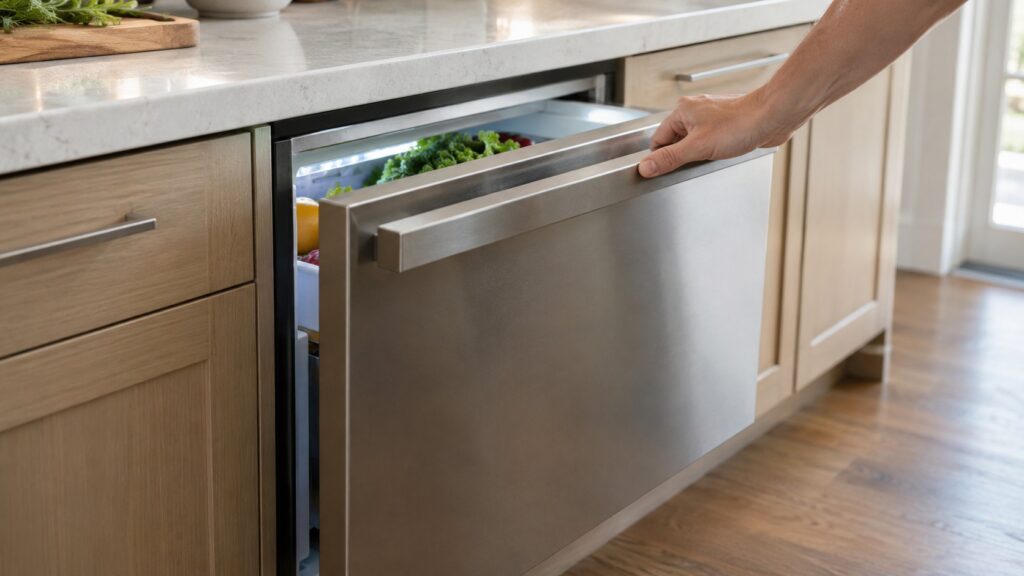
Very much. A freestanding appliance can be rolled out and swapped. A built-in drawer sits in a cabinet opening, often behind a matching panel, with ventilation and power arranged around it. Replacing it means a new unit that fits that opening and arrangement, the panel moved or replaced, and the work of removing and installing it. That tilts the decision toward repair for a single fault, more than for a freestanding product. It is also why a clear diagnosis matters: a sensor or a seal repaired in place keeps everything else exactly as it is.
If you are using the drawer in several modes, think about how much you rely on it. A drawer used as the overflow freezer for holidays can wait a week for a repair, while a drawer that holds wine or fresh food every day is worth fixing quickly. Move what is inside to another freezer or refrigerator while it is out of action, and do not refreeze anything that thawed.
One more practical point: write down what you see before the technician comes. Note the mode the drawer was set to, the temperature on the panel if it shows one, any alarm or code, the time it began and whether the drawer was recently loaded or moved. A good description is often enough to tell a sensor problem from a seal problem, and it lets the technician bring the right part. Keep the model number from the rating plate to hand as well.