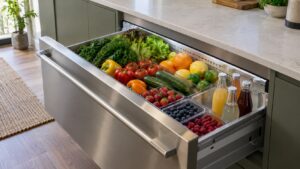

The Fisher Paykel CoolDrawer is the rare appliance that changes what it is depending on what you ask of it. Set it to Freezer and it is a freezer; set it to Wine and it holds cellar temperature and stops drying the corks; set it to Pantry and it is barely refrigerated at all. One drawer, five jobs. This guide explains how it does that, what each mode actually changes inside, and which symptoms point at the drawer rather than at the room around it.
One box, five setpoints — and more than a setpoint
Changing mode is not simply moving a dial. Each mode is a package: a target temperature, a way of running the fan and the damper to get there, and a defrost behavior that suits the contents. Freezer mode has to deal with frost; Wine mode deliberately avoids drying the air so much that corks suffer; Pantry mode does very little work at all and cycles rarely.
That is why the drawer takes time to settle after a mode change. Moving from Freezer to Wine means emptying a great deal of stored cold out of the compartment, and the drawer will read wrong for hours — normal behavior, and the reason to change mode when the drawer is empty rather than when it is full of dinner.
What the hardware is doing
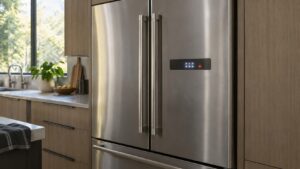
Inside there is a sealed refrigeration circuit, a fan moving air across a cold surface, a damper or airflow path, a sensor reporting temperature back, and a control that knows the recipe for each mode. On integrated installations it sits behind a cabinet panel, which is why installation quality — panel weight, hinge adjustment, seal contact — affects how well it holds temperature.
The same electronics family runs the brand’s wine columns, and they share a diagnostic style: the panel reports a fault indicator rather than publishing a numeric meaning, so the honest diagnosis path here is symptom-led. Our guide on how ActiveSmart works covers the sensing-and-airflow approach the brand uses across its refrigeration.
Reading the symptoms correctly
The drawer will not hold its selected mode. That is the fault worth reporting exactly that way. It points at the sensor, at the drawer seal, or at the control — three parts a technician tests directly, rather than at the compressor.
It holds Fridge but not Freezer. A useful clue. The system can reach moderate cold but not deep cold, which suggests a refrigeration capacity or airflow problem rather than a dead system.
Frost appears in Freezer mode. Look at the seal and at how often the drawer is opened before assuming defrost. Humid room air is the usual source, and a drawer is opened far more often than a door.
Wine mode, cabinet too cold. Check the mode is actually still set — a knocked control panel is common on drawers at hip height. If it is set, our page on a wine compartment running too cold covers what comes next.
There is one more reading worth knowing, because it looks alarming and usually is not: a drawer that runs almost continuously for the first day after installation or after a long power cut. It is pulling a warm compartment — and a warm cabinet panel — down to a setpoint from room temperature, and on the coldest modes that takes many hours. Judge it on the second day, with the drawer closed and left alone, rather than on the first evening.
Living with a drawer instead of a door
The overfilling problem is the one that generates the most calls that are not faults. A box of frozen food standing a half inch too tall holds the drawer open at the back, where nobody looks, and the compartment slowly loses its setpoint while the panel reports the mode it was told to hold.
Where it makes sense in a kitchen
A CoolDrawer earns its place where flexibility matters more than volume: a kitchen that needs a second freezer in December and a wine drawer in July, an island that needs cold storage where a full column will not fit, or a household that entertains and wants drinks chilled without filling the main refrigerator. It is not a replacement for a full column — it holds a drawer’s worth — and buying one expecting a freezer’s capacity leads to disappointment that is nothing to do with the appliance.
If the requirement is genuinely wine storage for a collection rather than for a case or two, the integrated wine column is the appliance designed for that job, and the two are often specified together.
If the house will be empty for a long stretch, think about which mode the drawer should hold while you are away. Pantry or Fridge keeps the compartment working gently with almost nothing to spoil in it; Freezer mode on a drawer holding food is a bet on the power staying on. Whatever you choose, empty anything perishable first — a drawer is small enough that its contents warm quickly if the power does fail, and a full freezer drawer that thawed and refroze is a harder problem than an empty one.
When to call
Call when the drawer will not hold the mode it is set to, when it holds moderate cold but cannot freeze, when frost returns after the seal and habits have been checked, when the panel shows a fault indicator, or when water appears under a built-in installation. Sealed-system and sensor work on an integrated appliance behind a cabinet panel is not owner territory.
We are an independent repair company, not a factory service arm. Pricing starts from a diagnostic visit — from $129 — with the estimate confirmed before work begins. Fisher Paykel wine refrigeration repair covers CoolDrawer units and integrated wine columns, and you can schedule a visit online.