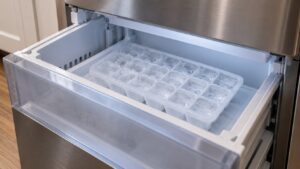
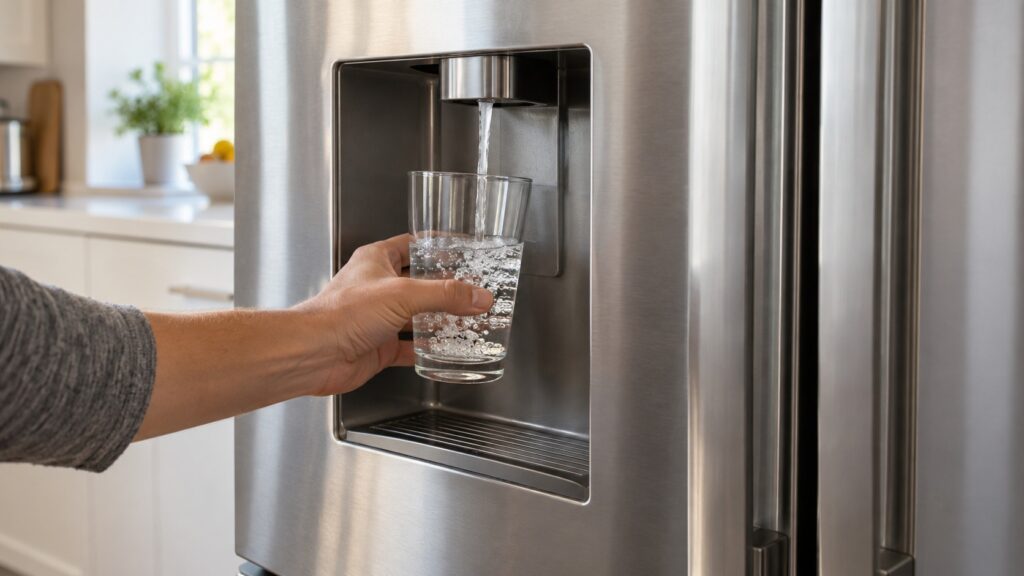
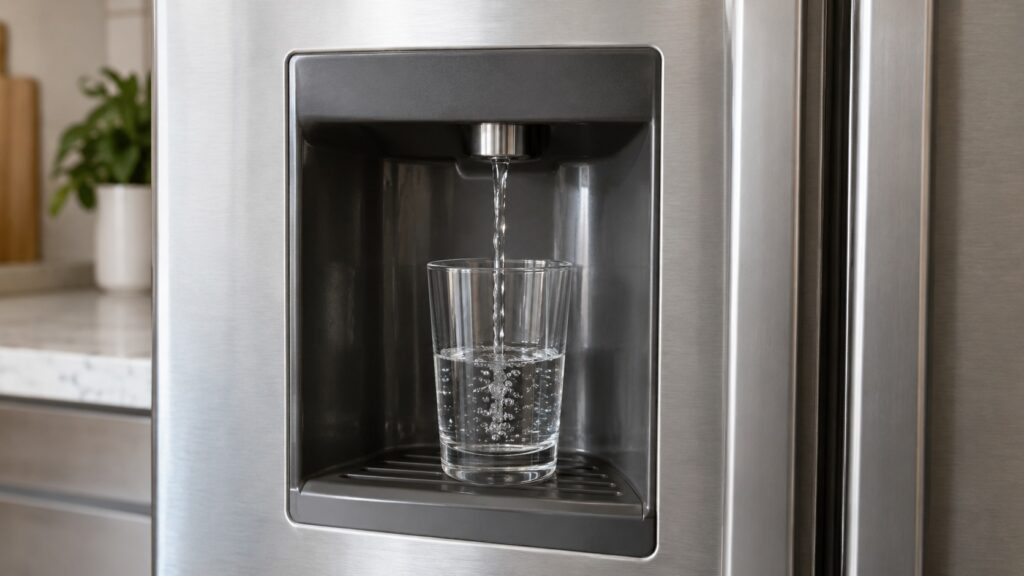
A Fisher Paykel fridge ice and water dispenser is a small plumbing system built into the door. Water comes from the house supply through a line to the back of the refrigerator, passes through a filter and an inlet valve, and runs to the door, where pressing the pad opens a valve and fills your glass. A separate ice maker makes ice from the same supply, stores it in a bin and delivers it to a chute when you ask. Most complaints are not about the dispenser itself: the control lock is on, the filter is overdue, the supply is closed or restricted, or a line has frozen. This guide explains how the system works and what each symptom points to.
How does water get from the tap to your glass?
Through a chain, and a weak link anywhere affects the whole thing. The supply line brings water to the refrigerator, usually from a dedicated shutoff valve on the cold water line. Our refrigerator installation guide says to use a dedicated shutoff valve, and notes that water pressure matters and that you should run water through the dispenser before using the ice to flush the line and filter. Water then goes through the filter and the inlet valve and on to the dispenser in the door. Exactly how it is routed depends on the model, so check your owner’s manual.
What does the filter do to the flow?
It cleans the water, and it slows it as it fills with particles. An overdue filter, or one that is seated wrongly, is a common reason for a slow trickle or a dispenser that gives nothing, and it can also leave the water tasting stale. Our guide to replacing the water filter explains the routine. After a new filter is fitted, flush the line as the manual describes before judging the water or the ice. Do not run the dispenser without a filter or bypass plug if your manual does not allow it.
What does the control lock do?
It switches off the dispenser pads so that nothing happens when they are pressed. Our water dispenser not working guide explains that the lock exists so a child cannot flood the kitchen, and that it is easy to trigger by accident while wiping the panel. A locked dispenser is silent: no click, no hum and no water. If your panel shows a lock indicator, your manual describes how to release it on your model. This is the first thing to check, because it costs nothing and is a very common cause of a “dead” dispenser.
How does the ice maker fit in?
The ice maker has its own inlet valve and fills a mold, freezes the water and releases the ice into a bin. The chute carries ice from the bin to the door when you press the ice pad. A very useful diagnostic follows from that: if the dispenser gives no water but the ice maker is still making ice, the supply is probably fine and the fault is on the dispenser branch; if neither works, the supply, the filter or the inlet valve is the likelier cause. Our ice maker troubleshooting guide and the ice maker page cover the ice side.
What does each symptom point to?
No water and no ice usually means the supply, the shutoff valve or the inlet valve. No water with ice still being made points to the dispenser branch: the door line, the dispenser valve, the pad switch or the control lock. Slow water suggests a restriction, such as an overdue filter, a partly closed shutoff or a pinched line. Ice in the chute but no water is a different problem again. Stale or cloudy water points to a filter past its life or a refrigerator that has stood unused. The water dispenser dead page lists the symptoms we see.
What can you safely do, and when should you call?
Check the control lock, the filter and the shutoff valve, make sure the line is not kinked and the door is closed, and look for ice in the chute or a frozen line if the dispenser is slow in cold weather. Do not open panels, remove the back of the refrigerator or disconnect fittings beyond what the manual describes. If water leaks from a fitting, shut off the supply, and if water is near an outlet or the cord, switch off the breaker at the panel while standing on a dry floor. Call a technician if the dispenser stays dead after the checks. Our Fisher & Paykel refrigerator repair page explains how a visit works.
Why can a line freeze or the ice stop in cold or hot conditions?
A water line that runs through a cold space, such as an unheated garage or an exterior wall, can freeze and block the flow, and a freezer that runs too warm lets ice melt and clump in the bin, which jams the chute. Our dispenser troubleshooting guide covers how a frozen line looks: water that slows to a trickle and then stops. Do not try to thaw a line with a heat gun or an open flame; switch the dispenser off, let the area warm gently and call a technician if it does not clear. Keep the freezer at the temperature your manual recommends so ice stays separate.
It also helps to use the ice and water regularly. Ice that sits for weeks can clump and taste stale, and water that has sat in the line can taste flat. Emptying the bin now and then and flushing a few glasses of water through the dispenser keeps both fresh, and it shows you early if something has stopped working.