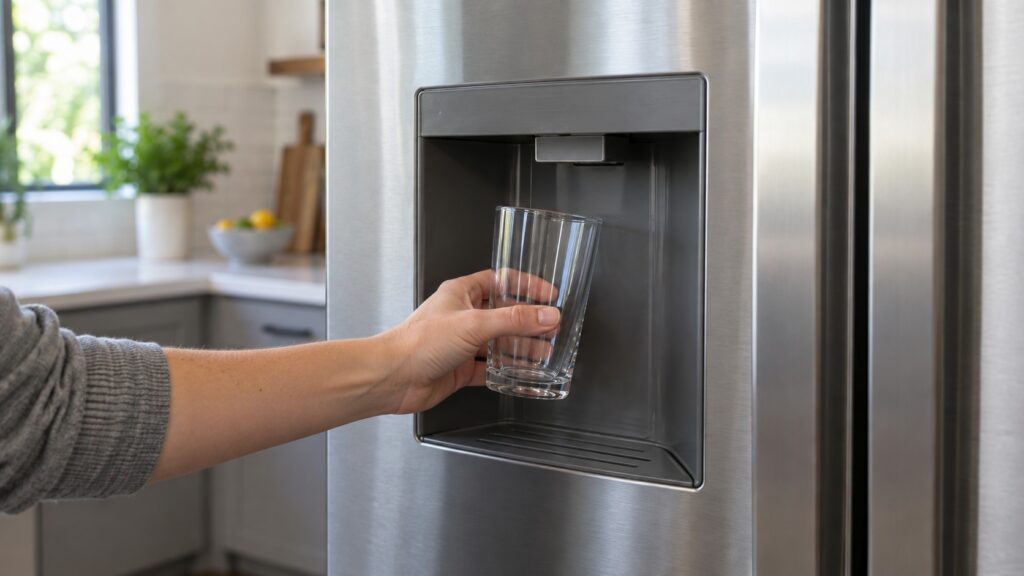
A Fisher Paykel refrigerator water dispenser not working is rarely a broken dispenser. In most cases the water never reaches it: the control lock is on, the filter is overdue or seated wrong, the supply line is closed or frozen, or the inlet valve has stopped opening. The dispenser arm and its switch are near the end of that chain, and they are the last thing to suspect, not the first.
Is the dispenser locked rather than broken?
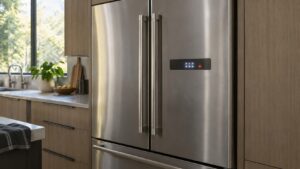
Start here, because it costs nothing and it is genuinely common. Fisher and Paykel refrigerators with a SmartTouch or ActiveSmart panel have a control lock that disables the dispenser pads — the feature exists so a child cannot flood the kitchen, and it is easy to trigger by accident while wiping the panel down.
A locked dispenser is silent. Press the pad and nothing at all happens: no click from a valve, no hum, no half-second of water. If the panel shows a padlock symbol, or a key or lock icon is lit anywhere on the display, hold the corresponding pad for a few seconds until the icon clears and try again. An unlocked dispenser that still does nothing has a real fault; a locked one has never been asked for water at all.
Could the water filter be the reason?
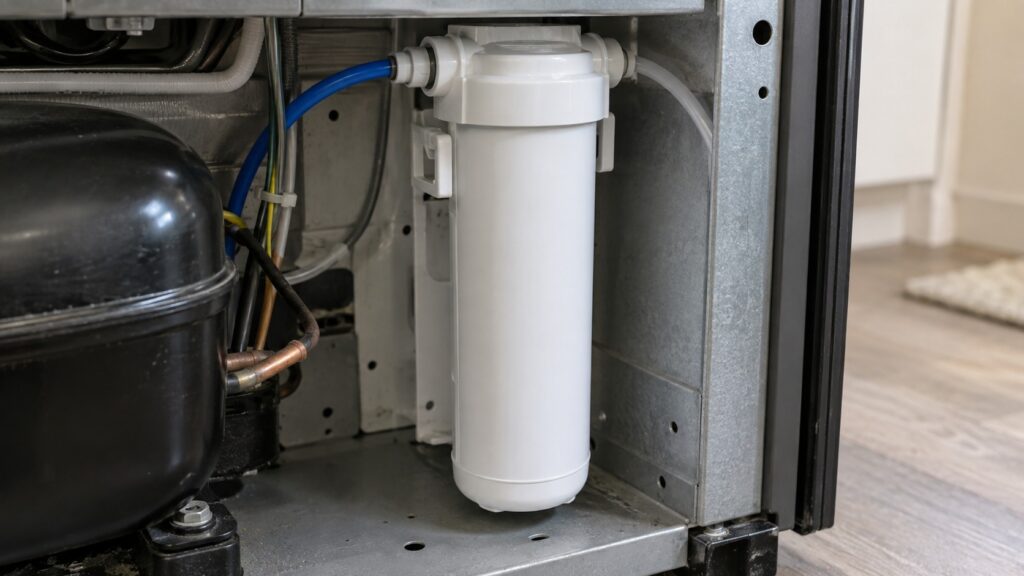
A filter that is past its service life is the most frequent single cause of weak flow, and a filter that was installed without being seated and turned fully home is the most frequent cause of no flow at all. Both look like a dead dispenser from the outside.
Two details matter. First, most housings hold the water back until the cartridge is fully engaged, so a cartridge that turned three-quarters of the way and stopped shuts the line completely. Second, a new cartridge holds air, and that air has to be pushed out before anything looks normal — expect spitting and several ounces of cloudy water before a clean stream. Flush a couple of quarts through before deciding the new filter is faulty. The routine is in our guide on replacing the water filter.
How do I tell a supply problem from a dispenser problem?
The ice maker answers this in one step, because it is fed from the same inlet valve but through a different branch.
- Ice maker dead too? The problem is upstream — the household shutoff, the line behind the refrigerator, or the inlet valve. Check whether the fridge has been pulled out recently; a line crushed against the wall is the classic result.
- Ice maker fine, dispenser dead? The problem is in the dispenser branch. On a door dispenser that means the line running through the door hinge, the dispenser valve, and the switch behind the pad.
- Both weak rather than dead? Pressure. A restricted filter, a partly open shutoff, or a house with genuinely low pressure will starve both.
Our page on a dispenser that will not dispense covers the same split, and ice maker problems is the right place to start if the ice side is the one failing.
Why does the water come out slowly instead of not at all?
Slow water is almost always a restriction rather than a failure, and the order of likelihood is short: filter, shutoff valve, line, pressure. A cartridge at the end of its life can cut flow to a trickle without any other symptom. A saddle valve at the house end that was never fully opened, or that has silted up over years, does the same. A line that has taken a tight bend behind the cabinet since the last time the refrigerator was moved does it too.
There is one more cause worth knowing about: the reservoir. Many Fisher and Paykel refrigerators chill water in a small tank inside the fresh-food compartment, and if that compartment is running colder than it should, the water inside can partly freeze. The giveaway is water that flows normally for a few ounces and then stops, recovering an hour later. That is a temperature problem rather than a plumbing one, and it is worth checking the compartment setting before anyone opens a panel.
Can the line freeze, and what does that look like?
Yes, and on a through-the-door dispenser it is common enough to check early. The vulnerable stretch is the short run of tubing that passes through the hinge area, where it is closest to freezing air. A frozen line gives no water, no drip, and no sound beyond the valve clicking uselessly.
The safe test is patience rather than heat: turn the dispenser off, leave the door closed, and try again the next day after setting the fresh-food compartment a degree or two warmer. Never use a heat gun, boiling water, or a metal probe in the chute — the tubing is thin plastic and the damage is immediate. If the line refreezes after a warmer setting, something is wrong with airflow or with the door seal, and our refrigerator installation guide covers the clearances and leveling that keep doors sealing properly.
When is this a service call?
Call when the filter is new and correctly seated, the control lock is off, the shutoff is open, the ice maker proves the supply is arriving, and the dispenser still gives nothing. At that point the remaining suspects are the inlet valve, the dispenser valve, the switch behind the pad, and the wiring that runs through the door hinge — and all of them sit behind panels with mains wiring and pressurized water on the other side.
Leave the door panel and the rear access cover alone. A water line disconnected under pressure empties into a kitchen faster than most people expect, and the dispenser harness in a door hinge is fragile and awkward to route back.
We are an independent repair company, not a factory service arm. Pricing starts from a diagnostic visit — from $129 — with the estimate confirmed before work begins. Fisher Paykel refrigerator repair covers inlet valves, dispenser valves, door lines and control panels, and you can schedule a visit online. Mention whether the ice maker still works: that one detail decides which half of the water circuit we arrive ready to test.