What Won't Fill means (fisher paykel washer won’t fill)
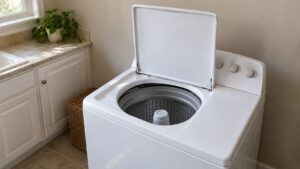
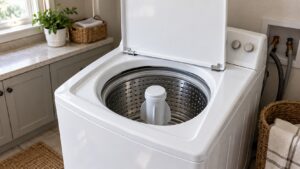
When a fisher paykel washer won’t fill, it is an observable condition — the bowl or drum stays empty or fills slowly. The machine often shows “No tap” when it cannot reach the required level in time. A closed tap, a kinked hose, or a clogged mesh filter are the everyday causes, with the inlet valve next.
Symptoms of a washer that won’t fill
A fill problem usually gives itself away at the very start of the wash, before any agitation begins. You might watch the bowl stay dry, hear the machine waiting with no rush of water, or see the cycle simply stall at the fill stage and refuse to move on. On many models the give-away is a “No tap” message or flashing HOT and COLD lights, all of which say the same thing: the water the machine expected did not arrive in time.
- The bowl or drum does not fill or fills very slowly
- “No tap” may appear on the display
- HOT/COLD lights may flash
- The cycle stalls at the fill stage
Likely causes of a no-fill
Trace the water’s path from the wall to the tub and the causes line up neatly along it. Start where the supply begins — a tap that is off or barely cracked open — then follow the hose for kinks, the mesh screens for debris, and finally reach the inlet valve that the machine controls electrically. Checking in that supply-side order means the simplest, no-tools fixes get ruled out before anyone reaches for the valve.
- Tap off or barely open — no or low supply
- Kinked inlet hose — flow is blocked
- Blocked mesh filter — the screen is clogged
- Faulty inlet valve — the valve will not open
What you can safely check on a no-fill
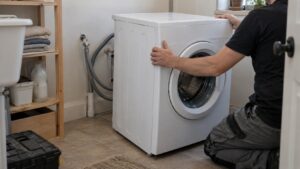
The good news with a fill problem is that the most common fixes need no panels off at all — they are all on the supply side, behind the machine. Confirm the taps actually run, straighten the hoses, and rinse the small mesh screens that sit at each hose end. These are genuinely owner-level checks. If full taps and clean filters still leave the tub dry, the problem has moved inside to the inlet valve and pressure system, which is the point to hand it to a qualified technician.
- Open both taps fully and confirm water runs from them.
- Unkink the inlet hoses behind the machine.
- Clean the small mesh filters at the hose and valve ends.
- If it still will not fill, book service to test the inlet valve.
Parts a technician may check or replace
If the basics check out, a technician follows the same supply path with the tools to test it properly. They may inspect, test, or replace the inlet hoses, mesh filters, water inlet valve, and supply taps, each matched to your washer’s model and serial number. Genuine parts are fitted through trusted parts suppliers rather than generic substitutes, and verifying that the valve really is the culprit before ordering avoids swapping good hardware for a problem that was upstream all along.
When to call a technician about a no-fill
A washer that will not fill with good supply and clean filters needs a technician to test the inlet valve and pressure system. When the fix calls for trained service, book a visit through our scheduling page and an experienced, qualified technician will diagnose and repair it.
Keeping fill problems from coming back
Because most no-fill problems start at the supply, a little upkeep there pays off. Leave the taps fully open between washes, route the inlet hoses so they cannot kink behind the machine, and clean the mesh inlet screens every so often, especially if your water carries grit or scale. A correctly rated supply with adequate pressure keeps the inlet valve from straining to reach level in time. When a fill problem appears, note when it started and what changed around then — a moved machine, a new hose, a plumbing repair — because that detail often points a technician straight to the cause and keeps the repair simple.
Related help and Fisher & Paykel resources
Browse other Fisher & Paykel Washer diagnostics, read about Fisher & Paykel Washer repair, look up your unit in the Fisher & Paykel models reference, or the related the “No tap” condition, browse service locations, or schedule a service visit. For Fisher & Paykel manufacturer documentation and model lookup, visit Fisher & Paykel at fisherpaykel.com/us.