What No tap means (fisher paykel no tap error)
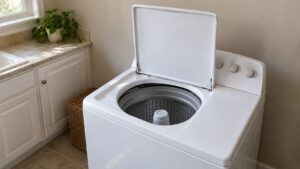
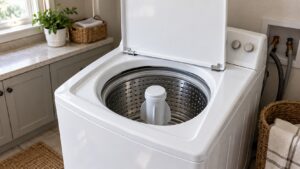
A fisher paykel no tap error means the washer is not getting water — it did not reach the required water level within about 8 minutes, so the machine flags a fill condition rather than a wash-quality problem. Digital top-loaders (FabricSmart, AquaSmart, CleanSmart) show the words “no tAP” with a beep every few seconds and flashing HOT/COLD lights; older WH front-loaders show literal “No Tap” with beeping; classic SmartDrive top-loaders signal it through flashing progress lights. The most common cause is simply a tap that is turned off or barely open.
Symptoms to look for
Since “No tap” is raised by a fill timer, every symptom traces back to the bowl staying empty when it should be filling. The tell-tale sign is that the beeping and flashing begin during the fill phase and not later in the cycle — that early timing is what marks this out from a drain stall or a motor stop. Spot any of the indicators below in the opening minutes of a wash and the trouble is almost certainly water supply, not the controller, on your Fisher & Paykel Washer.
- The display or lights show “No tap” / “no tAP”
- A musical beep repeats every few seconds during fill
- HOT and/or COLD lights flash
- The cycle pauses early because the bowl will not fill in time
Likely causes of the fisher paykel no tap error
Nearly every trigger for this no-water message lives somewhere along the path between the wall tap and the inlet valve, which is why the list below runs from the simplest household checks down to the single part that calls for a technician. Begin at the top: a shut tap or a pinched hose is behind most of these calls and takes nothing but a moment to rule out.
- Tap turned off or barely open — the most common cause by far
- Kinked inlet hose — water cannot flow to the valve
- Blocked mesh filter — the small screen at the hose or valve end is clogged
- Low pressure or flow — supply below the washer’s minimum
- Faulty inlet valve solenoid — the valve will not open (technician)
What you can check
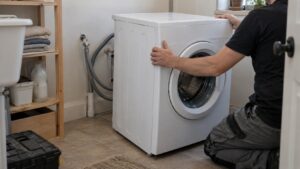
One helpful thing about a “No tap” fill problem is that the whole inspection takes place at the taps and hoses behind the machine, well clear of the sealed cabinet, so it stays safe for an owner to do. Work through the four steps below in order and note what each one reveals; if you get all the way to the inlet valve without spotting the cause, those notes hand the technician a head start. Never open the sealed cabinet, defeat a safety device, or touch live wiring while you do this.
- Open both hot and cold taps fully and confirm water actually runs from them.
- Unkink the inlet hoses and make sure they are not crushed behind the machine.
- Turn off the taps, disconnect the hoses, and clean the small mesh filters at both ends.
- Restart the cycle; if “No tap” returns with good supply and clean filters, the inlet valve likely needs a technician.
Parts a technician may check or replace
When the message outlasts clean filters and a verified supply, the focus shifts to the parts that physically push water into the bowl. A technician may inspect, test, or replace the inlet hoses, inlet-hose mesh filters, water inlet valve solenoid, and water supply taps. The right component for your Fisher & Paykel Washer is matched from its model and serial number, and quality parts are sourced through reliable suppliers rather than generic stand-ins so that both fill performance and the washer’s long service life hold up. Pinning down the failed part before any order goes in keeps the repair from touching more than the no-tap problem demands.
When to call a technician
If the taps are on, the hoses are clear, and the filters are clean but “No tap” persists, a technician should test the inlet valve solenoid and supply pressure. When the fix calls for trained service, book a visit through our scheduling page and an experienced, qualified technician will diagnose and repair it.
Prevention and care
Stopping a “No tap” message from returning comes down to looking after the water path feeding your Fisher & Paykel Washer. Twice a year, shut the taps and rinse the inlet mesh filters so grit never builds up enough to choke the flow, and leave room behind the machine so the hoses cannot fold against the wall. Keep both taps fully open between washes, and have any fresh install set so household pressure clears the washer’s minimum. Should the code show up again, write down exactly what the display and lights were doing before you reset — that quick note lets a technician confirm a valve failure instead of guessing at it.
Related help and Fisher & Paykel resources
Chasing this “No tap” fill timeout often points to neighboring reading: compare it with other Fisher & Paykel Washer diagnostics, see what Fisher & Paykel Washer repair covers, confirm your unit against the Fisher & Paykel models reference, or step over to the closely linked washer that will not fill, check service locations, or schedule a service visit. For Fisher & Paykel manufacturer documentation and model lookup, visit Fisher & Paykel at fisherpaykel.com/us.