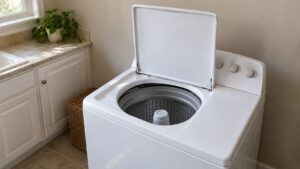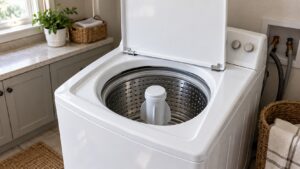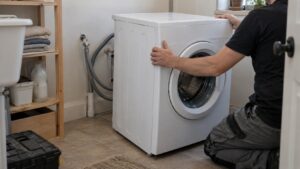
The top load vs front load washers question comes up in nearly every laundry-room conversation, and this guide settles it with engineering rather than marketing. The debate has a clear technical winner — but the “right” choice still depends on your priorities. Here’s an honest, side-by-side comparison drawn from how these machines are actually built and serviced.
Cleaning performance
Winner: Front-load. Front-load washers (like Fisher & Paykel’s lineup) use a tumbling action — clothes are lifted and dropped through the water repeatedly. This combines gravitational force with water agitation for more effective soil removal. Top-loaders use an impeller or agitator to move clothes through standing water, which is less mechanically efficient.
Independent testing consistently shows front-loaders remove 10-20% more soil than comparable top-loaders. The difference is most noticeable with heavy soiling and stains.
Water and energy usage
Winner: Front-load. Front-loaders use 13-17 gallons per cycle. Top-loaders use 20-30 gallons. Over a year (300 loads), that’s a difference of 2,100-3,900 gallons. Front-loaders also spin faster (1,200-1,600 RPM vs. 700-1,000 RPM), extracting more water and reducing dryer time and energy.
Cycle time
Winner: Top-load. Top-load cycles are typically 30-45 minutes. Front-load cycles are 60-90 minutes. If speed is your priority, top-loaders win. However, many front-loaders including Fisher & Paykel offer a “Quick 15” or “Speed Perfect” cycle for lightly soiled loads.
Ergonomics
Depends. Top-loaders don’t require bending to load and unload — an advantage for people with back problems. Front-loaders require bending or kneeling unless placed on a pedestal (adding from $$200 and 12-15 inches of height). However, front-loaders can be stacked with a dryer — see our stacking installation guide — saving floor space that top-loaders can’t.
Noise and vibration
Winner: Front-load (Fisher & Paykel specifically). Fisher & Paykel front-loaders with SmartDrive technology achieve 47-49 dB during wash. Top-loaders typically run at 55-65 dB. In apartment buildings, shared walls, or laundry closets near living areas, the noise difference is significant.
Maintenance
Winner: Top-load. Front-loaders require regular door boot cleaning to prevent mold and odor (see our door boot maintenance guide). The door must be left ajar between uses. Top-loaders have no door seal issue and can be closed between uses. This is the single biggest drawback of front-loaders.
Price
Winner: Top-load (upfront). Basic top-loaders start at from $$500. Front-loaders start at from $$800. Over a 12-year lifespan, the water and energy savings of a front-loader offset approximately from $$300 of the price premium — roughly breaking even.
Our recommendation
If you prioritize cleaning performance, efficiency, quiet operation, and stackability: front-load. If you prioritize speed, low maintenance, and lower upfront cost: top-load. Fisher & Paykel offers only front-loaders because their engineering philosophy prioritizes performance and efficiency.
Top load vs front load washers: key takeaways
Boil the top load vs front load washers decision down to two trade-offs and it gets simple: front-loaders win on cleaning, water use, energy, and noise, while top-loaders win on speed, low maintenance, and upfront cost. Decide which of those columns matters most in your home, and the answer picks itself — there is no universally “better” machine, only the better fit for how you do laundry.
Keeping your washer healthy long-term
The maintenance picture is exactly where a front-loader asks more of you. Leave the door and detergent drawer ajar between loads, wipe the rubber boot dry, and run a tub-clean cycle monthly to head off the mildew smell that plagues neglected front-loaders. Top-loaders are more forgiving here, but both styles benefit from never overloading the drum, which strains bearings and the drive system over time.
When a washer does need a technician — a no-drain problem, a boot leak, or a spin that won’t balance — keep the model and serial number from the rating plate inside the door frame on hand. Our team sources door boots, pumps, and drive components through trusted parts suppliers, backs labor with a 30-day warranty, and diagnoses before quoting, with washer service starting at from $129 depending on the diagnosis.