
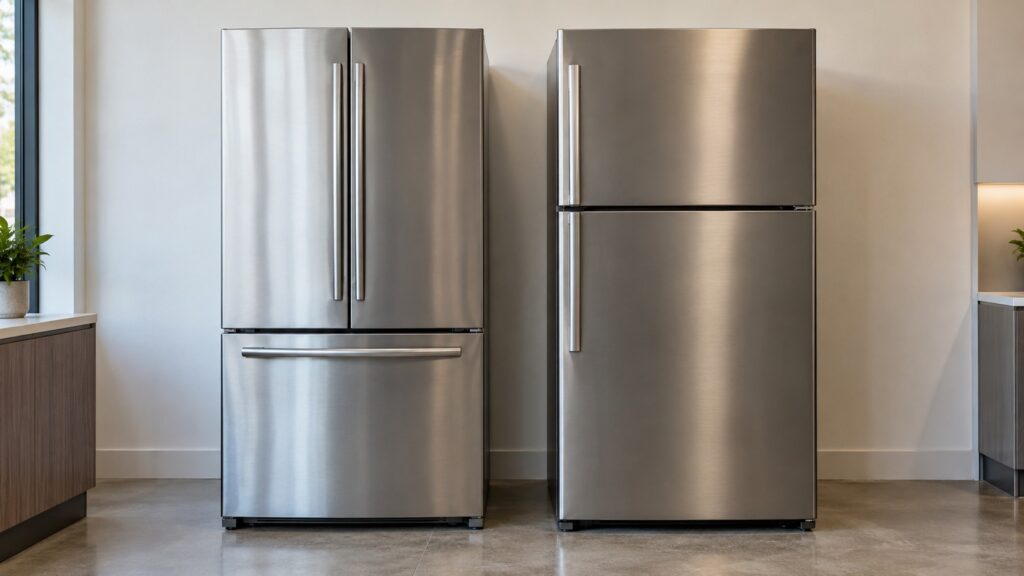
In a fisher paykel refrigerator vs bosch comparison, the useful questions are about layout, installation and how each fridge is built to be lived with, not about which badge is better. We repair Fisher & Paykel refrigerators, so what we say about them comes from our service work and from the pages of this site. About Bosch we say only that it sells refrigerators in several layouts, and we send you to each model’s own spec sheet for anything more. We make no claims about which brand is better, and we quote no prices or reliability figures, because we have no source for them.
Is a Fisher Paykel refrigerator better than a Bosch?
Neither is better for everyone, and anyone who tells you otherwise without knowing your kitchen is guessing. A refrigerator is chosen by fit and use: the width of the opening, the way you shop and cook, the door swing, and whether you want the fridge to disappear into the cabinets or stand as a feature. Both brands sell models that suit different answers to those questions. The sensible way to compare is to pick the exact models you can buy, then read their spec sheets side by side.
If your question is about layout rather than brand, our guide to French door vs side-by-side refrigerators compares the formats first, which narrows the field before you compare badges.
How does Fisher Paykel build its refrigerators?
Two features come up again and again on our service calls. The first is the format: Fisher & Paykel’s line on our site is built around integrated column refrigerators and freezers that are designed to sit flush with cabinetry, often with a custom or stainless panel, alongside French-door models. You size the fresh food and the freezer independently, which suits households that freeze in volume. The second is the cooling approach. Our explanation of how ActiveSmart works describes a system that spreads cold air through several outlets and manages temperature electronically to limit hot spots. Ask any retailer to show you the airflow design of the exact model you are considering.

What should you compare on the spec sheet?
Skip the marketing words and compare specific things. Check the outside dimensions and the opening the fridge needs, including the clearance for door swing and for airflow. Check the layout: which compartment is at eye level, where the freezer sits and how many shelves and drawers can be adjusted. Check the water and ice options, because a water line adds a plumbing requirement and a filter to look after. Check the controls and the display, because the icons and alarms differ by brand and by model. Our glossary of Fisher Paykel refrigerator display symbols shows what the panel on our models reports.
Then compare the installation. Panel-ready and built-in models need correct cabinetry depth and ventilation clearance, and professional installation is worth budgeting for. Our Fisher Paykel refrigerator installation guide lists what to check before delivery day.
How do running costs and upkeep compare?
We will not quote running costs for either brand, because they depend on the exact model and on how you use it. What we can say is that upkeep on any refrigerator comes down to the same habits: a clean door gasket, clear airflow around the condenser, a filter changed on schedule and a unit that stands level. Our annual Fisher Paykel refrigerator maintenance checklist covers these. Overpacking blocks the airflow outlets in any fridge, so the habit in our refrigerator organization tips is worth keeping whichever brand you choose.
How should you plan the kitchen around a new refrigerator?
Whichever brand you pick, plan the space before the delivery date. Measure the opening at the top, middle and bottom, because cabinetry is rarely perfectly square, and measure the path the fridge will take through doors, hallways and corners. Check which way the doors swing and whether they can open far enough to pull the drawers all the way out, since a drawer that cannot clear the cabinet next to it is a daily annoyance. Leave the clearance at the sides, top and back that the installation sheet asks for, because the installation sheet for your model sets the clearances it needs.
Think about the water line too. If the model has a dispenser or an ice maker, the supply line, the shutoff valve and the filter all need to be reachable. A line that is crushed behind the unit when it is pushed back is a common source of leaks later. And plan for the settling time: most refrigerators ask you to wait before loading them with food after they are moved, and your manual gives the period for your model. Taking these steps costs nothing and prevents most of the problems we are called to after a new installation.
What about repairs and keeping an older fridge?
A part swap is usually far cheaper than a new refrigerator, and a technician visit makes sense when the unit is not cooling, is leaking or shows a fault code. Before you replace a Fisher & Paykel that still has a sound cabinet, read our guide to repair or replace for a refrigerator. Diagnosis comes before shopping, because a fridge that only needs a sensor or a fan does not need replacing. Our Fisher Paykel refrigerator repair page explains how a visit works.
What is a sensible way to decide?
Write down your opening dimensions and your must-haves. Take a tape measure and a typical week of groceries, or at least a photo of one, to the showroom. Open the doors and drawers of each candidate and load them in your mind. Ask about installation, delivery and who services the unit in your area. Then decide on fit, not on a headline. If a brand-versus-brand question is still open after that, the answer is usually that both would serve you, and the difference will be in the details of your kitchen.