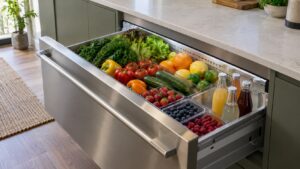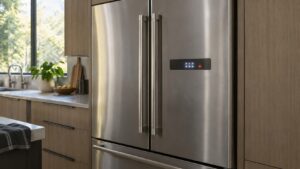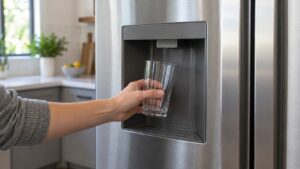
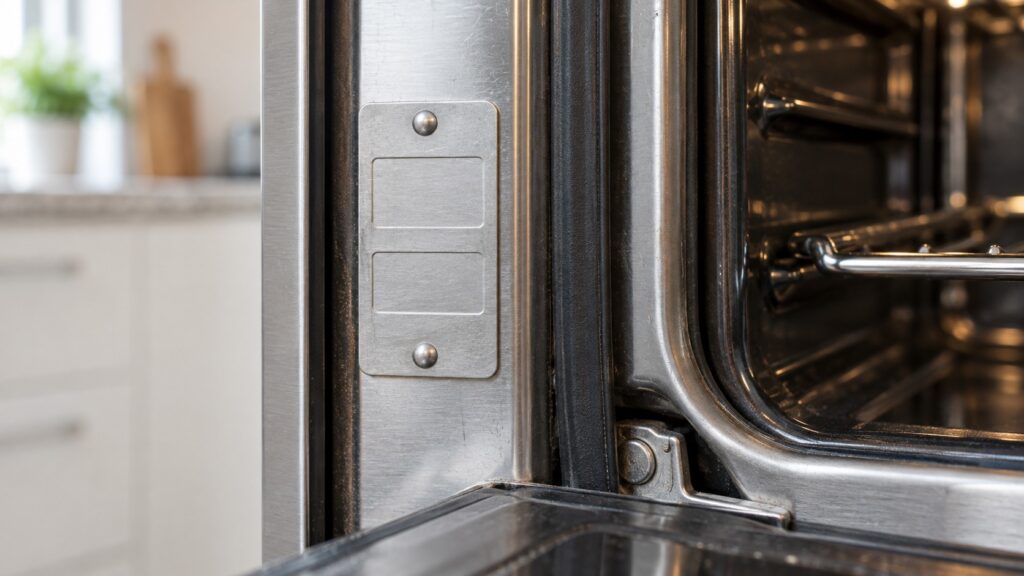
A Fisher & Paykel model number is not a random string — the letters at the front sort the appliance into a family before you ever reach a digit, and a technician reads that family before touching a tool. RS and RF, for example, are both refrigerators, but one is a built-in column unit and the other is a freestanding French-door model with a very different repair path. This glossary is a fisher paykel serial number lookup starting point: where the plate usually sits, what the leading letters tend to sort by, and why quoting the wrong three characters over the phone can send a part order in the wrong direction.
Why does the model number matter more than the appliance’s nickname?
Calling an appliance “the fridge” or “the dishwasher” tells a technician almost nothing about which parts fit it. Fisher & Paykel builds several distinct product lines inside each appliance category — a column refrigerator and a French-door refrigerator do not share a compressor, a door seal, or a control board, even though both keep food cold. The model number is what separates them before anyone opens a parts catalog, which is why every error-code page and every parts order on this site asks for it rather than the appliance’s general type.
How do you do a fisher paykel serial number lookup at home?
The rating plate carries both numbers together, and its location depends on the appliance type. On refrigerators and freezers it is typically just inside the door opening, on the cabinet wall rather than the door itself. On dishwashers and DishDrawer units it sits on the edge of the tub or drawer, visible once the door or drawer is open. On ranges, ovens and cooktops it is usually along the front frame or just inside a lower panel. If you cannot find it in the expected spot, your owner’s manual has a diagram for your specific model, since placement has shifted between generations.
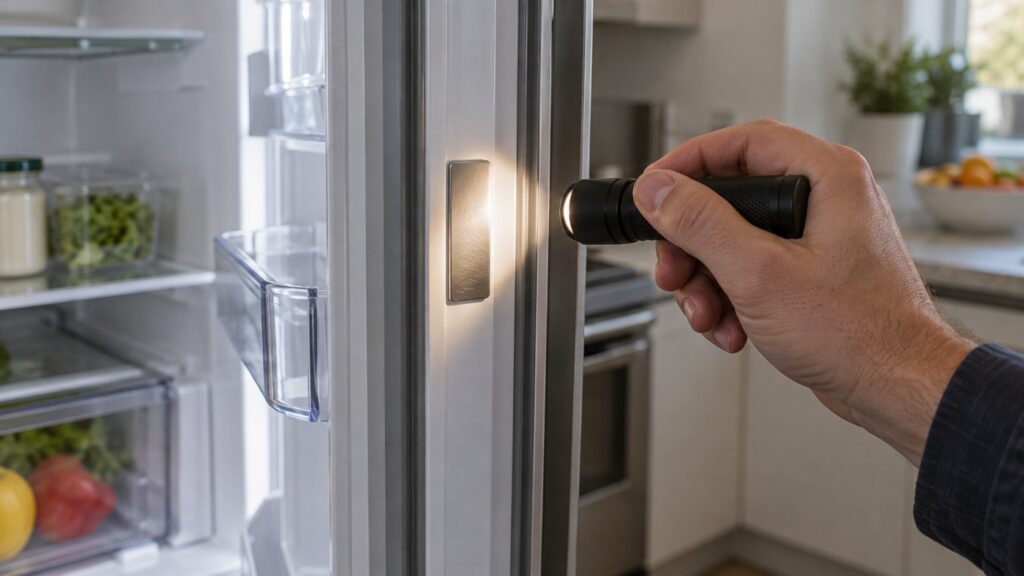
What is the difference between a model number and a serial number?
The model number identifies which appliance you own — the design, the features, the parts it takes. The serial number identifies your specific unit and typically encodes when it was built. A technician or a parts supplier needs both: the model number to find the right parts diagram, and the serial number to confirm which revision of that model you actually have, since a single model number can span several years of small part changes.
Why do RS and RF refrigerators need different service approaches?
An RS column unit is built into cabinetry as a single-purpose refrigerator or freezer, usually paired with a matching column elsewhere in the kitchen, and its compressor, evaporator and door hardware are sized and mounted for that built-in footprint. An RF French-door refrigerator is a freestanding unit with its own footprint, its own leveling feet, and a different ice-and-water dispenser layout in most configurations. Reading the code letters before a service call tells the technician which door hardware, which compressor mount, and which control layout to expect.
Why does DD vs DW change what a dishwasher repair looks like?
A DW model is a conventional single-tub dishwasher with one door, one wash motor and one pump. A DD model is a DishDrawer — one or two independent drawers, each with its own motor, pump and water path, sealed by a lid rather than a door. The failure patterns are different enough that a repair scoped from the wrong letter pair starts from the wrong assumption about how many motors and pumps the appliance actually has.
Why do OM, OS and OB wall ovens need different parts?
The oven letter group sorts by cavity type rather than by size alone. OM designates a single conventional wall oven — one cavity, standard bake and broil. OS designates a combination steam oven, which adds a water reservoir, a steam generator and drain path that a conventional oven simply does not have, so its parts list is longer and more specific. OB designates a double wall oven, with two independent cavities, two door assemblies and, in most cases, two separate control zones sharing one outer frame. A repair quoted from “the oven” without checking which letter group it belongs to risks quoting for a steam or dual-cavity part list on a machine that has neither, or the reverse — missing a steam component entirely on a model that needs one.
What should you have ready before calling for service or ordering a part?
- The full model number, read directly off the plate rather than from memory or a purchase receipt, since a digit copied wrong sends the wrong part.
- The serial number alongside it, especially for a part that has changed across a model’s production run.
- A photo of the plate if you are unsure which characters are the model number and which are the serial number — the layout differs by appliance and by age.
Our technicians confirm both numbers before a visit whenever possible, because it lets us bring the right parts on the first trip instead of a second one. We are an independent repair company, not a factory service arm, and pricing starts from a diagnostic visit with the estimate confirmed before any work begins.
If you have the model number in hand and a fault to go with it, our Fisher & Paykel refrigerator repair and dishwasher repair services both start from exactly this information, and you can schedule a visit with both numbers ready. For a DishDrawer specifically, our DishDrawer vs. dishwasher guide explains the DD naming in more depth, and our water filter replacement guide shows another place the model number decides which part is correct.