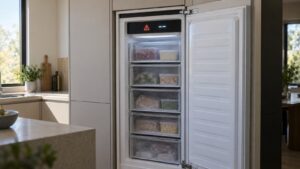
Getting your fisher-paykel freezer temperature settings right is the balance between food safety and energy efficiency. Too warm and food quality drops; too cold and the compressor works harder than it needs to.
Recommended fisher-paykel freezer temperature settings
For long-term food storage, aim for approximately 0°F (-18°C). This keeps food solidly frozen and halts the microbial activity that causes spoilage, while avoiding the energy penalty of running colder than necessary.
How to adjust the setting
- Use the digital control or dial to select the target temperature
- Allow up to 24 hours for the cabinet to stabilise after a change
- Verify with a standalone freezer thermometer placed between packages
Factors that affect the reading
- How full the freezer is — a fuller freezer holds temperature better
- Ambient kitchen temperature and ventilation around the cabinet
- Frequency and duration of door openings
- Condition of the door gasket
Signs the setting is wrong
- Soft ice cream or partial thawing suggests it is too warm
- Excess frost and freezer burn suggest it is too cold
When to seek help
If the freezer cannot hold the set temperature despite correct settings, a full cabinet, and a clean seal, the thermostat, control board, or sealed system may need service. Our technicians can verify the actual cabinet temperature and diagnose the cause.
Verifying the real cabinet temperature
Built-in displays show the setpoint, not always the true temperature between packages. A standalone freezer thermometer left in overnight gives an accurate reading. If it sits well above 0°F (-18°C) despite a correct setting, investigate airflow, seal, and load before assuming a component has failed.
Frequently asked questions
Is colder always better? No — running far below 0°F wastes energy and worsens freezer burn without improving food safety.
How long after changing the setting should I wait? Allow up to 24 hours for the cabinet to stabilise before checking the result.
Why does the temperature swing? Frequent door openings, a partially full cabinet, and a poor seal all cause swings; a fuller, well-sealed freezer holds steadier.
Balancing safety and efficiency
The recommended 0°F (-18°C) target exists because it reliably halts the microbial and enzymatic activity that degrades frozen food, without the energy penalty of running colder. Every few degrees below that adds to running costs and can worsen freezer burn through increased sublimation, while running warmer risks partial thawing and faster quality loss. Because the displayed setpoint and the true internal temperature can differ, verifying with an independent thermometer is the only way to be sure. Placement of that thermometer matters too: position it between packages in the middle of the cabinet rather than near the door, where readings are skewed by openings. If the verified temperature is stable and correct, the freezer is doing its job; if it drifts despite a correct setting, a full cabinet, and a clean seal, the thermostat or control board is the most likely culprit. A technician can confirm the discrepancy between setpoint and actual temperature and replace the faulty control, restoring both food safety and efficient operation.
When correct fisher-paykel freezer temperature settings still will not hold
There is a clear line between a setting problem and a hardware problem, and knowing which you are facing saves both money and food. If an independent thermometer confirms the cabinet drifts away from 0°F (-18°C) even though the setpoint is right, the load is adequate, and the gasket seals, the problem has moved from the dial to a component — usually the thermostat, the temperature sensor, or the control board that interprets it. Our experienced technicians measure the gap between what the display claims and what the cabinet is actually doing, which pinpoints the failing part instead of guessing from the symptom alone.
Where a thermostat, sensor, or control board turns out to be reading or commanding the wrong temperature, the replacement is sourced from trusted parts suppliers and matched to your model so the setpoint and the real cabinet temperature line up again. The work carries a 30-day labor warranty. We do not give a fixed quote before checking the unit, because a sensor and a control board differ in cost; temperature-control service generally starts from a standard call-out and depends on what the diagnosis reveals.
Adjusting the dial and verifying with a thermometer are entirely safe to do yourself, and they should always come first. But once those checks point to a faulty control, the repair reaches into the mains-voltage wiring inside the cabinet, where a specialist is the safer choice. If a correct setting still will not hold, that is the time to call. You can book online whenever suits you, and we coordinate appointments across all 50 states.
If a correct setting still will not hold temperature, our specialist technicians can help — book a repair online 24/7, browse our freezer repair services, or review the related freezer error codes and model specifications. For original product documentation, see the manufacturer site at fisherpaykel.com.