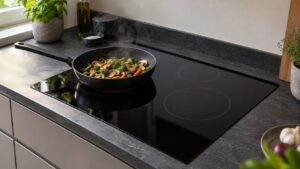
Curious about how fisher-paykel induction cooktops work? This guide breaks down the science behind the glass surface, explained by experienced appliance technicians who service these cooktops daily. Induction cooktops don’t generate heat — they generate a magnetic field that makes the cookware itself produce heat. This fundamental difference makes induction faster than gas, more precise than electric, and safer than both.
The electromagnetic principle
Under each burner zone, a coiled copper wire carries alternating current at 20,000-100,000 Hz. This creates a rapidly oscillating magnetic field above the cooktop surface. When a ferromagnetic pan (cast iron, magnetic stainless steel) is placed on the zone, the magnetic field induces electrical currents (called eddy currents) in the pan’s metal. These currents generate heat through electrical resistance — the pan heats itself.
The glass cooktop surface stays cool because it’s not ferromagnetic — the magnetic field passes through it without generating heat. Any warmth you feel on the glass is residual heat transferred back from the hot pan, not generated by the cooktop.
Why it matters for cooking
Speed
Induction is the fastest cooking technology available. A Fisher & Paykel FlexInduction zone can boil 1 liter of water in about 3 minutes — roughly twice as fast as gas and three times faster than radiant electric. The energy goes directly into the pan with minimal loss.
Precision
Induction responds to temperature changes instantly. When you lower the power, the magnetic field weakens immediately and the pan cools down within seconds. Gas has a 10-15 second lag; radiant electric has a 30-60 second lag. For sauces, chocolate, and temperature-sensitive cooking, this precision is transformative.
Safety
No open flame. The surface stays cool (or warm only from the pan’s residual heat). Auto-shutoff engages if no pan is detected for a set period. Pan detection means the burner won’t activate without compatible cookware — a wooden spoon, towel, or hand on the glass triggers nothing.
Efficiency
Induction transfers 85-90% of energy to the food. Gas transfers 30-40%. Radiant electric transfers 65-70%. This efficiency means less waste heat in your kitchen — your range hood works less and your AC runs less in summer.
Cookware compatibility
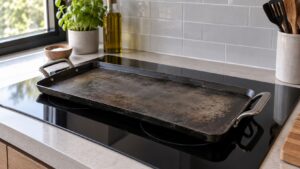
The pan must contain ferromagnetic material. Test with a refrigerator magnet — if it sticks strongly to the bottom of the pan, it works on induction. Compatible:
- Cast iron (including enameled)
- Magnetic stainless steel (most stainless steel cookware works — check with a magnet)
- Carbon steel
Not compatible: aluminum, copper, glass, ceramic. Some manufacturers make these with a ferromagnetic disk bonded to the bottom — these work but with slightly reduced efficiency.
Fisher & Paykel FlexInduction
Fisher & Paykel’s FlexInduction zones combine multiple induction coils into a large, flexible cooking area. You can place pots and pans anywhere on the zone, in any size or shape, and the system activates only the coils under each pan. This allows oversized pans, griddles, and non-round cookware that wouldn’t work on fixed circular burners.
For induction cooktop service or installation questions, schedule an appointment with our specialist Fisher & Paykel technicians.
How fisher-paykel induction cooktops work: key takeaways
Once you grasp how fisher-paykel induction cooktops work, the magnetic-field principle explains everything else — why the glass stays cool, why only ferromagnetic pans heat, and why power changes register instantly. Match your cookware to the zone, keep the surface clean, and the technology rewards you with speed and precision no other cooking method matches.
Keeping your induction cooktop performing long-term
An induction cooktop has fewer moving parts than a gas burner, but the glass surface and the coils beneath it still benefit from care. Wipe spills promptly so sugar and starch don’t bake onto the ceramic, and avoid sliding heavy cast iron across the glass, which can scratch or crack it. If a zone stops recognizing a pan, fails to power up, or throws an error, the induction coil or its control board is the likely culprit rather than the cookware.
When you do need parts, have your model and serial number ready — on Fisher & Paykel cooktops these are printed on a label beneath the unit or in the paperwork from installation. Our technicians source replacement induction coils and control boards through trusted parts suppliers, back labor with a 30-day warranty, and diagnose before they quote, with cooktop service starting at from $129 depending on the diagnosis.