
Few appliance choices carry as much weight as whether to repair or replace fisher-paykel refrigerator units, mostly because of the high purchase price (from $1,800 for Fisher & Paykel models) and the long 13-to-17-year lifespan that hangs in the balance. Move too quickly to replace and you waste money; cling to a dying unit and you waste even more. For current model details you can consult Fisher & Paykel.
The compressor question
The compressor is the dividing line. For any non-compressor repair on a unit under 12 years old, repair almost always makes sense. Compressor replacement (from $500) is the repair that triggers the hardest decision — see our refrigerator repair cost guide for detailed pricing.
Compressor failure at 0-7 years: Repair
The unit has substantial remaining life. The compressor may even be under Fisher & Paykel’s sealed system warranty (5 years on some models). Check your warranty documentation.
Compressor failure at 8-12 years: Case by case
If the rest of the unit is in good condition (no rust, good seals, working electronics), a new compressor gives you 5-7 more years. But if the evaporator or condenser also shows corrosion, you’re looking at cascading sealed-system failures.
Compressor failure at 13+ years: Replace
At this age, investing from $700 in a compressor on a unit that may need a new control board, fan motors, or seals within 2 years doesn’t make financial sense.
Non-compressor repairs: almost always repair
Thermostat, fan motor, defrost system, ice maker, water valve — these are all from $120 repairs that extend the life of an otherwise sound appliance. Replacing a $2,500 refrigerator because of a $180 fan motor is a $2,320 mistake.
Energy efficiency argument
A 2016 Fisher & Paykel refrigerator uses roughly 450 kWh/year. A 2026 equivalent uses 350-400 kWh/year. At $0.15/kWh, that’s from $8/year in energy savings. It takes 100+ years to recoup the purchase price through energy savings alone — this is not a valid reason to replace a functioning refrigerator.
Signs replacement is overdue
- Rust on interior walls or around door hinges
- Compressor runs continuously (even after coil cleaning)
- Multiple repairs totaling $500+ in the past 12 months
- Refrigerant leak requiring recharge — leaks tend to recur
- Interior condensation that won’t resolve (insulation failure)
Get a professional assessment — schedule Fisher & Paykel refrigerator diagnostics and get a clear repair-vs-replace recommendation based on your specific unit.
Repair or replace fisher-paykel refrigerator: key takeaways
The decision to repair or replace fisher-paykel refrigerator models really turns on one component: the compressor. Almost everything else is a cheap, life-extending fix worth doing, while a failed compressor on a unit past 13 years is the classic case for upgrading. Energy savings alone never justify replacing a fridge that still runs.
Protecting your Fisher & Paykel refrigerator over the long haul
The compressor lasts longest when it is not fighting a layer of dust. Vacuuming the condenser coils a couple of times a year, leaving room for airflow around the cabinet, and checking door seals for a tight close all reduce the sealed-system strain that drives the hardest repair-or-replace decisions. The ActiveSmart cooling system handles temperature and humidity automatically, but it relies on clean coils to do it efficiently.
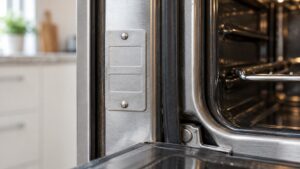
When you schedule service, record the model and serial numbers from the rating plate — typically inside the fresh-food compartment on a side wall or the door frame of Fisher & Paykel refrigerators. Those digits let a technician confirm your exact sealed-system layout and whether the compressor still falls under the manufacturer’s coverage.
Compressor and refrigerant repairs are sealed-system work governed by EPA handling rules and belong with specialist technicians, never a DIY attempt. Non-sealed parts like fan motors, thermostats, and water valves should still come from a trusted supplier and match your model to preserve the ActiveSmart cooling balance.
If the fridge throws a problem while you are deciding, our error code reference explains what it means before you commit either way. A temperature reading might trace to a frosted sensor or a door left open, while a recurring sealed-system or board failure on an aging unit can be the deciding signal toward replacement.
When the call is genuinely close, our technicians evaluate the whole appliance — coils, seals, electronics, and rust — rather than the single failed part, and give you a straight recommendation. Labor carries a 30-day warranty, the diagnostic fee applies toward any approved repair, and pricing starts from the figures above. Book a refrigerator visit online or call to discuss your unit.